Author: Buy2Greece

  • Buy2Greece.com – China’s retirees: an emerging force in global property markets

    340 million – that’s the forecasted China’s greying demographic aged 60 and above by 2030.1

    That’s an increase of 175 million from the current count of 165 million Chinese retirees1 – a figure that not only exceeds the current population of the US2, but also makes them an emerging force in global property markets that will amount to one of the world’s largest consumer base.

    More importantly, this massive market of China’s silver generation has equally substantial funds at their disposal.

    Older Chinese are sitting on a hefty share of the $2.4 trillion in savings3 planted in China’s banks4, having lived through China’s boom years, benefited from rising incomes, and capitalised on China’s fast-growing property markets.

    Already, their wealth is already impacting global property markets, albeit indirectly. Chinese insurers, custodians of billions of RMB in retirees’ pension and insurance plans, are steadily channelling their cash piles into global property markets, investing $3.1 billion in overseas real estate in H1 20165, and with a further $73 billion expected to follow by 2019.6


    China’s silver generation more globally savvy and discerning

    Aside from insurers, individual retirees – or those planning for future retirement – are now becoming much more active in global property markets, in part because their horizons are broadening.

    The waves of outbound tourists from China, which numbered 120 million in 2015 and is projected to hit 139.2 million this year, are becoming more globally savvy as they get to know more countries around the world, and older generations are well and truly part of this outbound trend.

    The China Outbound Tourism Institute estimates tourists aged 60+ accounted for 5 million trips in 20157 and China Britain Business Council estimating a US$34 billion potential spend from this age group.8

    In fact, another recent Citi report revealed that outbound tourism by Chinese elderly have skyrocketed as much 217% last year alone.9

    Increased awareness of overseas opportunities gives retirees more options to build an overseas lifestyle as well.
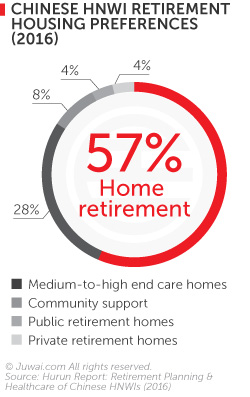
    57% of Chinese high net worth individuals (HNWIs) prefer to retire in a home of their own, in preference to care homes.10

    This is because times are changing, and no longer are China’s rich and wealthy completely adhering to the Confucian ethic of filial piety, whereby Chinese children take care of their elderly parents when they are unable to care for themselves.

    Instead, Chinese HNWIs are now in pursuit of independence after retirement, an option that came about due to a growing awareness of the pressures placed upon their children – most who are a single child born under the one-child policy – as well as a desire to not burden them, if possible.11

    And for this silver generation, ‘independence after retirement’ translates into living away from their children as they search for relaxed and enriching lifestyles that come hand-in-hand with plenty of travelling around.


    Healthcare a top focus for China’s elderly
    That said, with China’s dubious environmental quality, many Chinese retirees are on the lookout for an overseas property with access to both top quality medical care and attractive living environments while jet-setting around the world.

    In fact, Chinese spent $10 billion on medical tourism in 2015 alone, of which Chinese retirees are an important part of this market – and it’s this growing market that is helping to spur property investment in destinations famed for medical treatments, such as in the US.

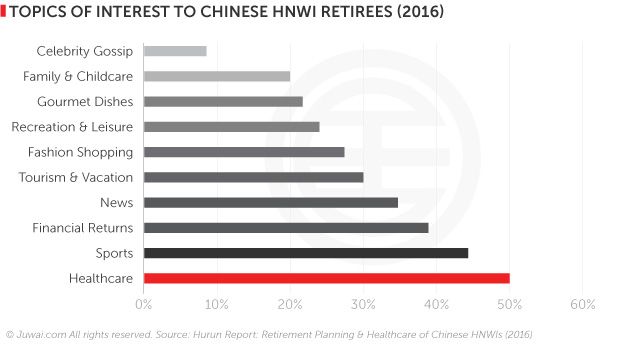
    50% of China’s HNWIs cited healthcare as their primary concern and main topic of interest for 2016.10
    Asides from lifestyle concerns, Chinese retirees are also generational investors who also want to ensure that they are providing for the next generation.

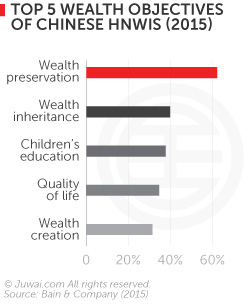
    According to research from Bain & Company, Chinese high net worth individuals factored inheritance, children’s education, and life quality as three of their top five wealth objectives.12

    With this in mind, an overseas property in a suitable location not only offers a Chinese retiree a unique opportunity to meet their lifestyle aspirations, but also provides both a springboard for their children and grandchildren to enjoy overseas educational opportunities, as well as securing a high-value asset which they can pass on to the next generation.


    Connectivity, easier visas, and better pension access broadening retirees’ horizons

    Even as Chinese mentality is changing, so is the world to make it easier than ever for Chinese retirees to seek an overseas retirement.

    Today, China has become more closely connected with the world, driving what Boeing expects will be a 3x increase in total passengers travelling between China and the US alone by 2021.13

    This factor, together with expanding international transport links from China’s lower-tier capitals, will open up many more opportunities for travel, and make it more feasible for retirees to split time between bases at home and overseas.

    Countries all over the world are opening their doors to Chinese investors too. Recent moves by Singapore, Australia, the UK, and the US to increase multiple entry visa validity for up to 10 years – plus the raft of ‘golden visa’ residency programs offered by locations such as Portugal, Spain and Greece – all mean that Chinese retirees are now spoilt for choice when it comes to choosing overseas retirement locations.

    Interestingly, China’s government is making it easier than ever before for retired Chinese residents living overseas to claim their pensions as well.14 Previously, a convoluted claim procedure meant that many overseas-based Chinese retirees gave up seeking their pensions. However, this policy change now recognises their overseas status, thus giving them greater confidence in supporting themselves overseas.


    A greying economy but a golden opportunity

    Powerful demographic trends, an increasingly outward looking customer base, and improving links between China and the outside world are aligning to create a high-potential market of Chinese retirees looking abroad for property.

    Furthermore, Chinese retirees have money to spend – China’s state-run Research Centre on Ageing forecasts total expenditure by Chinese retirees to reach RMB1 trillion by 2050.15

    So agents, it’s time you tailor your offerings to suit China’s older generation. Here are three ways how:

    • Educate them: An overseas investment is a huge step, particularly a Chinese investor with little knowledge of property sales procedures in new countries. So, be sure to manage expectations by including a step-by-step breakdown of a sales process as part of your product pitch, outlining fees and levies clients will expect to pay as part of the process, and explaining terms associated with a property, e.g. freehold, tenancy.
    • Put yourself in their shoes: While they may be commonplace in the UK, US, Canada or Australia, most Chinese – particularly the older generation – haven’t grown up with gardens, garages or pools. So do some research to find out what features may appeal to them, and make sure you put features like this front and center in your pitches to add more allure to your properties.
    • Highlight local facilities: Health and education are a huge concern for China’s silver generation, so be sure to offer details of medical, wellness, and educational institutions in the local area. Chinese investors are looking to tick as many boxes as possible with their property purchases, so pack your pitches with as much relevant information as possible.

    Chances are, strategies like these can win you interest, trust, and completed deals from China’s retirement-minded property investors, so good luck with your promotions, and here’s to a golden return from China’s greying economy.


    Sources: 1. Brookings Institute: China’s one-child policy at 30; 2. US News: US population in 2015; 3. Naked Capitalism: The puzzle of China’s rising household saving rate; 4. Wikipedia: List of countries by GDP; 5. Fortune: Why Chinese investment in overseas real estate has more than doubled; 6. SCMP: The Chinese are coming: Insurers expected to pour US$73b into overseas properties; 7. COTRI: Elderly Chinese, a market segment of increasing importance; 8. China-Britain Business Council: China’s silver consumers; 9. Citi Report on SCMP: Goodbye tour buses and loud hailers: Chinese tourists now choosing the more personal approach; 10. Hurun Report: Retirement Planning & Healthcare of Chinese HNWIs 2016; 11. Jing Daily: China’s rich opt for luxury nursing homes over filial obligations for aging parents; 12. Bain & Company/China Merchants Bank: China Private Wealth Report; 13. Boeing: Current Market Outlook: 2015-2034; 14. China Daily: Simplified process helps Chinese retirees in US get pensions from overseas; 15. SCMP: Navigating through China’s grey economy
  • www.Buy2Greece.com -Turkey tourism receives another setback as US urges citizens to avoid travel

    The U.S Department of State has updated its travel warning for Turkey post the political turmoil and attacks by Islamic State and the PKK (the Kurdish Worker’s Party).

    “U.S. citizens should avoid travel to southeast Turkey and carefully consider the risks of travel to and throughout the country,” the most recent travel advisor says.

    “Foreign and U.S. tourists have been explicitly targeted by international and indigenous organizations in Turkey.”

    Already battered tourism which declined by 80% over the past 16 months in Turkey has received another blow with the latest travel advisory.

    According to Mehmet Nuri Osden, incoming manager of Argeus, a tourist agency in Turkey, foreign tourism has dropped some 80% with a 90% drop in American tourists.

    At its peak, the country saw roughly 37 million tourists in 2014, according to the Ministry of Culture and Tourism in Turkey.

    According to the Turkish Statistical Institute, as of July 2016, income from tourism decreased by almost 36% and the number of departing visitors shrank by one third.

    The country has been embroiled in a bloody five year civil war since 2015. In June 2016, ISIS terrorists attacked Istanbul Ataturk Airport, Turkey’s busiest international hub, killing some 45 people followed by a coup to overthrow President Recep Tayyip Erdogan and the Turkish government organized under the Peace at Home Council and said to be followers of the self-exiled, US-based cleric, Fetullah Gulen.

    In August, a teenage suicide bomber killed some 53 people at a wedding party near the Syrian border. Most recently, on October 9, a car bomb killed roughly 18 people in southeastern Turkey.

    All these has had a tumultuous effect on the once booming tourism sector in Turkey.

  • www.Buy2Greece.com – New restaurants unveiled at Silversea Cruises

    The themes and names of the Silversea Cruises will be added to its new fleet Silver Muse which will be delivered next year.

    The new ship will feature 8 restaurants, many of which are new to the line. Silversea says this ship will have “more dining options than any other ultra-luxury cruise ship,” showcasing line’s commitment to great food onboard.

    The four are La Dame, a French restaurant; Kabuki, a Japanese restaurant; the pan-Asian Indochine; and Silver Note, a jazz club that will serve tapas-style dishes.

    La Dame’s menu will be created by Relais & Chateaux and feature locally sourced ingredients and wine pairings.

    Previously announced dining venues include Atlantide, a European-style seafood grill that also serves steak; La Terrazza, buffet by day and Italian, Slow Food-inspired restaurant by night; Hot Rocks, an alfresco restaurant by the pool where passengers grill their own seafood and meats; and Regina Margherita, an outdoor, all-day pizzeria, also found near the pool.

    The 596-passenger, all-suite Silver Muse will debut in Monaco next year as the largest ship in the Silversea fleet. Suites are available in all sizes – the smallest veranda suite is a roomy 387 square feet – and include one- and two-bedroom versions of Owner’s, Grand and Royal Suites.

  • www.Buy2Greece.com – Airbnb gets new regulatory rules on New York City hosts

    Beginning November 1, individuals in New York City who rent out multiple homes will be assigned to follow a new rule where they will be allowed to list one apartment for rent to Airbnb.

    Airbnb is a peer-to-peer online marketplace and home-stay network that enables people to list or rent short-term lodging in residential properties. The company faced pressures from politicians and tenants’ rights groups saying the company has worsened affordable housing issues in the city. The company also said, in a proposal to city officials, that it was willing to create a registry of hosts to make it easier for the state to enforce housing rules and that it would create a hotline for neighbours’ complaints.

    According to the new rules, the short-term rentals in public housing will also be prohibited.

    In rent-controlled units, tenants would only be able to rent up to the level of their rents, or a portion of the income would be re­invested into upkeep of their building. A “three strikes” policy will be instituted which will permanently ban the rule breakers. The online system will be set up for the hosts to register the rentals.

    Airbnb has cast the rules as aiming to make sure New Yorkers who are sharing their homes occasionally to make ends meet should be protected as to those who commercial operators who run illegal hotels and take the housing off the market. New York lawmakers called the proposal “a Hail Mary” attempt to get around a bill that went to New York Governor Andrew Cuomo. The bill would fine illegal Airbnb operators in the state.

    New York state senator Liz Krueger said that the proposal is an attempt to do the same thing in New York which has failed in San Francisco.  Registration and taxation has not worked in any city where Airbnb as nobody actually registered.

    The San Francisco-based company’s money doesn’t come from people living in their own homes renting out a room or a bed while they’re there, which is legal, said New York Assembly Member Linda Rosenthal.

    The 2010 New York law was written prior to their platform’s wide scale use and represented “horse and buggy laws” in an age of automobiles. But it focused on the fact that the middle class hosts using the platform to make ends meet in a legal way during a time of growing income inequality.

    New York is not the only place where regulators are attempting to change Airbnb’s business practices. In the company’s hometown of San Francisco, there were new discussions on legislation would limit short-term rentals to no more than 60 days a year.  Hosts who had complied with the city’s registration requirements, who the city believes are in the minority, would continue to be able to offer 90 days of unhosted rentals a year and unlimited hosted ones.

  • www.Buy2Greece.com – Chinese investors join hands with Russian tour operator for tourism cluster

    Grand Baikal, the Russian tour operator, has entered into a deal with Chinese investors to create a “world-class tourism cluster” on the shores of the world’s deepest lake in Siberia.

    A consortium of Chinese firms headed by Chungjingxin will invest $11 billion in the project that will include tourist attractions, transport and logistics infrastructure.

    A memorandum of cooperation, backed by the governor of Siberia’s Irkutsk region, Sergei Levchenko, was signed last week. A feasibility study is underway before the final agreement is signed.

    “We are planning to build not only up-to-date tourist attractions, but to create an accompanying transport and far-reaching logistic infrastructure around Lake Baikal to attract a significant number of tourists to the region,” Grand Baikal said.

    The initiative may jump start social and economic development of the region, according to the statement.

    According to the company, an important condition for the project is observing basic ecological standards and environmental laws to protect one of the world’s natural wonders.

    The new tourist hub is expected to be built on the site of a former paper mill in the town of Zabaykalsk. The mill was shut down three years ago, and was the lake’s biggest source of pollution.

  • www.Buy2Greece.com – Gay tourism in Spain increases over 28% in 2016

    Spain’s gay tourism growth trajectory is on the upward with recorded figures showing that 28% increase over 2015 and 34% higher than the average figures recorded in previous summers.

    The average spending of gay tourists is more than 30% higher than spending by tourists generally, a recent study conducted by Cromosomax reveals. The study has been conducted in collaboration with a group of party promoters, owners of gay bars, accommodation managers focusing on the LGBT community and specialized travel agencies.

    The study helps to explain why every year more destinations try to attract more gay travelers.

    It is estimated that the gay tourist spends about 130 euros a day on entertainment and dining, beating the average tourist by, among other factors, their greater presence and social activity.

    Gay tourism contributes more than 9 billion euros a year to the Spanish economy, which is 18% of total tourism revenue.

    The gay tourists came mostly from the UK, Germany and the US and visited already established Gran Canaria, Ibiza, Sitges, Torremolinos and Benidorm. Barcelona joins this list which turned out to be the big attraction for summer 2016.

  • www.Buy2Greece.com – CNR Emlak – Real Estate Investment Projects and Financing Fair which will be held between the dates of 17 – 20 November 2016, at CNR Expo Center, Istanbul.

    CNR Emlak – Real Estate Investment Projects and Financing Fair which will be held between the dates of 17 – 20 November 2016, at CNR Expo Center, Istanbul.

    http://cnremlakfuari.com/index.aspx?ln=2

  • Buy2Greece – Spain becomes medical tourism hub, expects to attract 2 lakh annual medical tourists

    Spain is becoming a hotspot for medical tourism. Contributing 500 million Euros annually to the state exchequer, the Spanish medical tourism is expected to hit an astounding figure of around 2 lakh annual medical tourists.


    Spain being an already popular tourist destination has helped its medical tourism domain to strengthen its ground and emerge as a leading global medical tourism destination as well.

    To further boost this tourism sector the Spanish Government signed a collaboration agreement with other interested proponents under the brand name of ‘Spaincares’ in 2014 to make the country one of the prime global leaders offering top quality medical facilities and treatments.

    ‘Spaincares’ is a strategic consortium of the leading Spanish tourism companies and healthcare providers.

    What gives Spain medical tourism an extra edge is the fact that there is no need to have a special medical visa as medical tourists can have a tourist visa alone to meet their health care objectives in Spain. However, they need to have a valid passport and a bonafide visa.

    Affordable medical treatment in Spain has furthered its popularity. When compared to other countries in Europe and the US, the cost savings range from 30 % – 70 % in this country.

    The Spanish healthcare system is highly advanced. According to the World Health Organization (WHO) ranking, Spain enjoys the distinguished status of having the 7th best health care system in the world.

  • Buy2Greece- Computer system meltdown causes worldwide flight delays

    Dozens of United Airlines flight has been delayed worldwide after  a “systems issue” has cropped up.

    A spokesman for United told the media that, they are aware of an issue with their systems that is resulting in flight delays. They are working to resolve the issue and get the customers to their destination as soon as possible. They have apologized for the inconvenience caused.

    More than 60 flights are known to have been delayed. The first flight from the UK was due out from Heathrow at 7.30am, to Washington DC, but left an hour late. Passengers were told it was “delayed due to operational difficulties”.

    United is the world’s third-biggest airline, after Delta and American.

    United Airlines later announced on its Twitter that the issue was resolved at 8.15am UK time, and all flights have resumed.

    In August, Delta Airlines – the world’s biggest carrier – experienced a worldwide systems failure which led to the cancellation of hundreds of flights and delays to thousands more. The airline blamed a power problem, and denied that its system had been breached, but cyber-security experts were skeptical.

    Passengers expressed their frustration for the delay through various social media platforms.

  • Buy2Greece – Space tourism to become a reality by 2020

    If you are still stuck on the new trends of tourism on earth like medical tourism, eco tourism or sustainable tourism, then it is very likely that you are missing on
    the bigger picture, SPACE TOURISM! Yes, you read it right. If two private space companies are to be believed, by 2020 you can go on vacation somewhere in Earth’s orbit.

    Bigelow Aerospace and Axiom Space say they’ll have commercial facilities available by 2020. They announced their intentions this week at the 2016 International Symposium for Personal and Commercial Spaceflight.

    Bigelow, which produces compressed habitat modules that expand when they reach their destination, already has a test module attached to the International Space Station.

    Private spaceflight will allow NASA to turn its attention to Mars exploration while enabling more people than ever to experience space, the companies say.

    “Hopefully, if we’re successful in the private-sector community, NASA’s going to save a boatload of money, on multiple locations [in orbit] – not just one – with more volume than they’ve ever had before,” Bigelow founder and chief executive Robert Bigelow said.

    The comany is planning to connect its forthcoming B330 modules together to create enough spac for four guests at a time, accompanied by three Bigelow employees.

    Axiom Space intends to attach its seven-person habitat by 2020 and leave it connected until the end of the ISS’s life.

    Dennis Tito was the first self-funded “space tourist” in 2001.