Buy2Greece.com
Buy2Greece.com
The Museum has rich collections of objects, representing the following disciplines of folklore: The collections exhibited in the Museum, an area of 450 m, as follows: The ground floor is a large room with the costumes, the uniforms of soldiers of the Balkan Wars, the vestments of St. Nektarios, the sacred utensils, wood carvings, jewelry and” urban” corner. The room with the household utensils and separate rooms with the Office of Library and Archives (Photo, Ichothiki, Film Archive) and the photo lab. Upstairs are the rooms that represent the living room and bedroom in the typical form, the room with the loom and weaving, the three smaller rooms with embroidery and knitting and the hall of the forms and images of Kimi and the life wave benefactor of mankind C. Papanicolaou. Upstairs is the store of folklore. The basement is kiroplasteio, the area of laundry and the traditional basement with cellar and farm tools. Also syntiritirio and cafeteria. In the garden of the Museum has built outdoor 250-seat circular theater, where there have been many events such as theatrical performances, lectures, concerts of classical music and artistic Greek songs and film screenings by the Film Club Association. In the village of Pyrgos Kimi,” in private” Chrysanthopoulos Mansion Annex operates the museum, the collection of popular 19th century artist Sotiris Chrysanthopoulos with the diverse talent in secular and religious work such as icons, frescoes, reliefs and the library consisting of incunabula editions. The Museum collaborates on a permanent basis or as appropriate, with universities, the International Council of Museums (ICOM), Research Centres, Museums like, Libraries. Galleries and private scientists to carry out the research objectives. The Museum has documented his collection, which maintains scientifically. It offers visitors informative multilingual guide. He has participated in exhibitions and TV shows in Greece and abroad and has significant publishing activity. The museum is visited by many students in organized visits to schools, contributing significantly to the cultural tourism in the region. The multipurpose room, the expansion of the museum, used for lectures, seminars, exhibitions, educational programs and especially adult learners, necessary and complementary uses of the operation of the museum, according to the perceptions of modern Museology. Weaving (mainly silk and gossamer tiriplenia) Embroidery (especially cocoon frames and white embroidery) Apparel (men’s and women’s bridal, party, weekdays) Metalwork Ceramics Wood Carving Folk art (works G.D ‘Esposito, Sot. Chrysanthopoulos). Stone carving
πηγή – http://www.evia-guide.gr/en/places/%CE%B1%CE%BE%CE%B9%CE%BF%CE%B8%CE%AD%CE%B1%CF%84%CE%B1-%CF%83%CF%84%CE%B7%CE%BD-%CE%B5%CF%8D%CE%B2%CE%BF%CE%B9%CE%B1/folklore-museum-kymi.html
Buy2Greece.com
Americans are becoming more optimistic about buying a home, with 67% of people saying they plan on purchasing a home, and of that amount, 32% are looking to buy within the next two years.
The PulteGroup (PHM) Home Index surveyed 1,004 adults on their sentiment about the U.S. economy and how current housing conditions are impacting future homebuyers.
According to the survey results, 74% of adults feel the economy has remained steady or improved in the last year.
As a result, 57% of adults think now is a good or excellent time to purchase items they want or need, especially when it comes to entering the housing market.
Millennials and move-up buyers are the most engaged consumer segments, with 85% and 71%, respectively, intending to purchase a home in the future.
“For the first time in years, Americans have a growing sense of optimism that the housing market is improving, and that these positive changes may be sustainable,” said Margaret Gramann, senior vice president of sales for PulteGroup.
“This favorable outlook is giving them the confidence to pursue more meaningful, big-picture life opportunities they may have otherwise put on hold,” Gramann added.
There are two main drivers to purchasing a home: the need for more space and the view that owning a home is a smart financial investment.
Currently 70% of home shoppers plan to spend as much or more money on their next home, along with 64% of people saying they prefer to spend on a home that’s move-in ready rather than spend less and renovate.
“Whether it’s a first-time or move-up buyer, or an active adult, purchasing a home is a major life decision and Americans are recognizing the importance of maximizing what they view as a long-term investment,” said Gramann. “They’re aiming to create value in a home that meets their specific wants and needs from day one, and if that means spending more money, they’re willing to do so because of confidence in the market.”
And as consumer demand for housing increases, so does the demand for more credit.
For borrowers who already have a home, the demand for home equity lines of credit is increasing.
Experian found a 41% increase in originations year over year, with 70% of HELOCs coming from super prime consumers. See the inforgraphic for more detail (click image for bigger picture).
Buy2Greece.com
Does a pool add value to a home? No. And yes. 
In general, building a pool is not the best way to add value to your home. You’re better off making physical improvements to your actual house instead of adding a pool to your yard.
However, a pool can add value to your home in some cases:
Still, that’s no guarantee you’ll get a return on your investment. At most, your home’s value might increase 7% if all circumstances are right when it comes time to sell. Those circumstances include the points made above, plus:
But only you, the homeowner, can determine the true return on investment. A pool can add value to your quality of life and enhance the enjoyment of your home. You can’t put a price tag on that.
But we can put a price tag on how much a pool costs to build and maintain.
The Cost to Build a Pool
The average cost in the U.S. to install, equip, and fill a 600-sq.-ft. concrete pool starts at $30,000.
Add in details like safety fences (most states require them), waterfalls, lighting, landscaping, and perhaps a spa, and you’re easily looking at totals approaching $100,000.
Costs also depend on the type of pool you choose.
Gunite is the most popular in-ground pool. Gunite is a mixture of cement and sand, which can be poured into almost any shape. It has replaced concrete pools as the sought-after standard.
Fiberglass shells and those with vinyl liners fall on the lower end of the budget scale, but the liners typically need replacing every 10 or so years. Changing the liner requires draining the pool and replacing the edging (called coping), so over time, costs add up. Most homebuyers will insist that you replace a vinyl liner, even if it’s only a few years old.
Filtration and Heating
The filtration pump is the biggest energy hog in a pool system, so you want to get the most efficient pump possible. The good news here is that new, variable-speed pumps use up to 80% less energy than old single-speed pumps, cutting operating expenses dramatically.
At about $500, these cost more up front, but some local utilities offer rebates through participating pool dealers. You can further cut energy costs by setting the pump to run at non-peak times, when rates for electricity are lower.
If you’re planning to heat your pool, gas heaters are the least expensive to purchase and install, but they typically have the highest operation and maintenance costs. Many pool owners opt instead for electric heat pumps, which extract heat from the surrounding air and transfer it to the water. Heat pumps take longer than gas to warm the pool, but they’re more energy-efficient, costing $200 to $400 less to operate per swimming season.
Regardless of heating system, covering the pool with a solar blanket to trap heat and reduce evaporation will further lower operating costs.
Maintenance Expenses
All pools require that the water be balanced for proper pH, alkalinity, and calcium levels. They also need sanitizing to control bacteria and germs, which is where chlorine has traditionally entered the picture.
These days you have a variety of options, including systems that use bromine, salt, ozone, ionizers, or other chemical compounds that can be less irritating to skin. Chlorine remains the most popular because the upfront costs are reasonable, and you don’t have to be as rigid about checking the levels on a set schedule. But as far as your wallet is concerned, they all even out in the end.
In a seasonal swimming climate, budget about $600 annually for maintenance if you shoulder the chemical balancing and cleaning yourself; in a year-round climate, it’s more like $15 to $25 per week.
To save yourself the task of once-a-week vacuuming, you can buy a robotic cleaning system for between $500 and $800 that will do the job for you. In locations where the pool must be opened and closed for the season, add another $500 each time for a pro to handle this task.
Insurance and Taxes
A basic homeowners insurance policy typically covers a pool structure without requiring a separate rider, but you should increase your liability from the standard amount.
It costs about $30 a year to bump coverage from $100,000 to $500,000. Many underwriters require you to fence in the pool so children can’t wander in unsupervised.
In some areas, adding a pool may increase your annual property taxes, but it won’t necessarily add to your home’s selling price. For that reason, try to keep your total building cost between 10% and 15% of what you paid for your house, lest you invest too much in an amenity that won’t pay you back.
source: http://www.realtor.com/
The sales of vacation homesskyrocketed last year. A recent studyalso revealed that 25% of those surveyed said they’d likely buy a second home, such as a vacation or beach house, to use during retirement. For many Baby Boomers, the idea of finally purchasing that vacation home (that they may eventually use in retirement) makes more and more sense as the economy improves and the housing market recovers.
If your family is thinking about purchasing that second home, now may be the perfect time. Prices are still great. If you decide to lease the property until you’re ready to occupy it full time, the rental market in most areas is very strong. And you can still get a great mortgage interest rate.
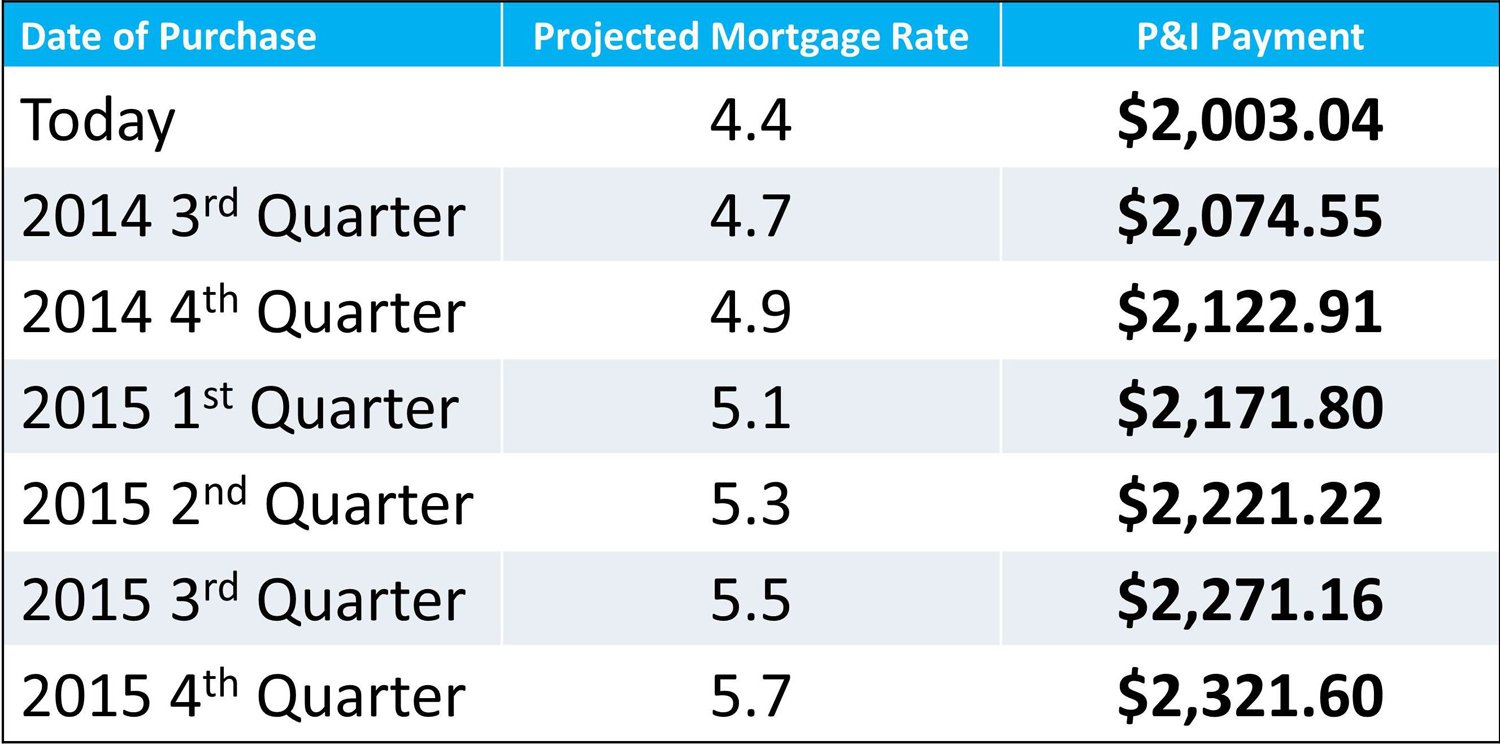
According to FreddieMac, the interest rate for a 30 year fixed rate mortgage at the beginning of April was 4.4%. However, FreddieMac predicts that mortgage rates will steadily climb over the next six quarters.
Let’s assume you want to purchase a home for $500,000 with a 20% down payment ($100,000). That would leave you with a $400,000 mortgage. What happens if you wait to buy this dream house?
Prices are projected to increase over the next year and a half. However, for this example, let’s assume prices remain the same. Your mortgage payment will still increase as mortgage rates climb to more historically normal levels.
This table shows how a principal and interest payment is impacted by a rise in interest rates:
If you are a real estate professional and want a deeper understanding of how market conditions will impact buyers this spring, please join us Thursday at 2PM ET for a free webinar entitled: Spring Ahead in 2014: KCM’s Action Plan for Dominating the Spring Buyers’ Season.
Buy2Greece.com
The International Coalition of Tourism Partners (ICTP) is very pleased to release the second edition of “e-Futures” with greenearth.travel and Urban Green Energy. This quarterly newsletter presents case studies, inspiring innovations, and other technological advances in renewable energies applied to the “travelism” (travel&tourism) sector.
ICTP supports e-Futures – as it spotlights first movers and pioneer projects in clean energies and inspires the travel&tourism sector to embark on the green growth transformation. It is a good example of the typical support services you`ll get for free as an ICTP member. To discover the ICTP hub – expertise in green growth&travelism, promotion&global outreach, impact investment, climate change&renewable energies, vision for sustainable tourism, Chinese visitors, and community events support – and join ICTP, go to http://www.ictp.travel now!
Buy2Greece.com
The Chinese entrepreneur, Zhang Yue plans to build the largest and most sustainable building in the world in the middle of the Chinese province Hunan, in only seven months. He aims to totally revolutionise the building industry, which evidently would have an effect on all sectors involved.
In the framework of his keynote visionary speech at the 65th edition of the FIABCI World Congress which will take place from 20 to 22 May 2014 in Luxembourg, Zhang Yue will show what role in particular architects play in these times of an economic U-turn.
Sustainable, five-times more energy-efficient buildings that also save land and materials, and are thus low-cost – are the objectives of BROAD Group, a Chinese prefab building company chaired by founder Zhang Yue, a 54-year-old Chinese with a college degree in fine arts. The man, who is a passionate creative thinker, has already obtained a multitude of patents for his inventions, such as the pressure-free hot water boiler, the direct-fired chiller for non-electric air conditioning and a revolutionary air purification technology with an electrostatic cleaner. His most recent completed project however, the T30, a 30-storey hotel built in only 15 days, has made him, as well as the company itself, internationally popular. The secret of how to build such a huge building in such a short time span is as easy as it is clever: BROAD buildings are based on standardised pre-manufactured plates which only have to be assembled on-site. This technique, in contrast to traditional construction which is – according to Zhang Yue – too time-consuming and generates unnecessarily high amounts of waste, is much more cost-efficient, time-saving and mainly environmentally friendlier. But if that is not enough, the Chinese revolutionary wants to go even further with his probably most highly debated plan: SkyCity, an 868-metre high tower which will house more than 30,000 people as well as offices, schools, a hospital, recreation and sports centres, a giant shopping mall and even an organic farm. In addition, there will be also up to 10 km of walking streets within the building. The theory is that as people do not have to leave the building anymore to go to the hospital or grocery shopping, they will not have to use cars – enabling a tremendous reduction in CO2 emissions.
Zhang Yue, with his revolutionary plans, could not be a more appropriate key person at the FIABCI 65thWorld Congress, especially for the first half of the second congress day on 21 May, 2014, being devoted to the topic ‘Cities and Technology’ and bringing the sector’s top decision-makers together for conferences, debates and workshop sessions. The day’s opening speech will be given by Aimé Shyirambere (Senior Project Manager at Solum Real Estate). Another highlight: the debate of the World Council of Managers includes, besides Zhang Yue, Rüdiger Fritsch (Lawyer at Krall, Kalkum&Partner Gbr), Adrian Joyce (Secretary General of EuroACE), Wolfgang Feist (Founder of Passivhaus Institute) and Martin von Hauff (President of FIABCI World Council of Managers) for discussions on the latest developments within the sector. This fine selection of important speakers makes the Luxembourg congress – dedicated to real estate professionals worldwide – an event not to be missed.
Buy2Greece.com
When Google talks, hotel marketers need to listen, especially when it comes to responsive website design. With mobile traffic gaining market share month after month, hotels need to ensure their desktop versions of their websites are optimized for smaller screens and deliver fast loading times. Lodging Interactive, the interactive and social media marketing agency exclusively servicing the hospitality industry and winner of numerous prestigious awards for its website design services, says the more responsive a hotel website, the higher its SEO rankings on Google, and the easier it will be to maintain.
“SEO is a core component of any business’ digital marketing strategy, and as such Google has gone so far as to call responsive web design an industry best practice,” said DJ Vallauri, Lodging Interactive Founder and President. “For hotels, this means keeping content on one website and one URL, making it much easier for travelers to share, interact with, and link to than content that lives on a separate mobile site. Some hotels have learned quickly that trying to build separate sites for mobile and tablet environments is exhaustive for staff, and it presents potential duplicate content issues with Google which negatively effects organic search engine results.”
Responsive websites turn visitors into customers. According to a study conducted by Sterling Research and SmithGeiger for Google:
· 96% of consumers say they’ve encountered sites that were clearly not designed for mobile devices
· 75% of users prefer a mobile-friendly site
· 67% of users are more likely to buy from a mobile-friendly site
· 61% of consumers say that they’d quickly move onto another site if they didn’t find what they were looking for right away on a mobile site.
· 52% of users said that a bad mobile experience made them less likely to engage with a company
· 50% of people said that even if they like a business, they will use them less often if the website isn’t mobile-friendly
· 48% of users say they feel frustrated and annoyed when they get to a site that’s not mobile-friendly
and if the site didn’t work well on their smartphones, it made them feel like the company didn’t care about their business
“This research confirms that mobile users actively seek out and prefer to engage with mobile-friendly, responsive sites,” Vallauri said. “Travelers attitudes about your hotel can quickly and easily be shaped by mobile site experiences. Having a great mobile site is no longer just about making a few reservations; it’s become a critical component of building a strong brand image, nurturing customer loyalty, and making the hotel’s mobile strategy work for the property and the brand.”
Source:-Lodging Interactive
Buy2Greece.com
The Third Industrial Revolution
The convergence of the internet and energy is slowly taking place: connected buildings and self-sufficient in energy, with new models where consumers become the energy producer. Real-estate technology buildings are flourishing, with a bright future ahead. Whether they be specialised in data collection or wind-system power management, our needs are multiplying in terms of progress made by the sector .
About 1,000 decision-makers from 60 countries will meet up in Luxembourg in May to discover what Luxembourg has to offer in terms of IT, financial, real estate and lifestyle solutions. It will enable professionals to learn more about the latest trends in these fields. When talking about IT and real estate, there are two guest speakers not to be missed: Jeremy Rifkin, economist and thinker, author of the book ‘The Third Industrial Revolution’ and Zhang Yue, a Chinese billionaire at the origins of the Sky City Project – the future highest tower in the world. He is also known for building high-end and hyper-technological buildings including one which has 30 storeys and which was built in only 15 days.
For the first time in 65 years, the FIABCI World Congress will be held in Luxembourg and we are proud to welcome these renowned speakers.
FIABCI is one of the oldest real estate federations and the choice of where to hold its international summit is often competitive. Each year it chooses another capital, in another continent and in 2014, it will return to Europe. Luxembourg won against…Rome.
The main part of the event will be held in the New Conference Center Kirchberg, but also at the Rockhal, Cercle Cité, Cercle Münster and the closing evening is being held at Goodbye Monopol. This is truly an event which you cannot afford to miss.
Luxembourg has chosen the topic ‘Building humanity’. If you want to find out what you can expect to experience at the event, but also why hotels are about to be fully booked from 19 to 22 May in your capital this year, visit this website !
Buy2Greece.com
Από την Μεγάλη Εβδομάδα ξεκίνησαν οι πρώτες πτήσεις τσάρτερ για τη Ζάκυνθο με τουρίστες από χώρες της βόρειας και κεντρικής Ευρώπης.
Με αυτές τις πτήσεις εγκαινιάζεται ουσιαστικά και η φετινή τουριστική περίοδος με μαζικό τουρισμό, που σύμφωνα με τις εκτιμήσεις των πρακτόρων του νησιού, αναμένεται να έχει πολύ θετικούς ρυθμούς σε σχέση με την περυσινή χρονιά η οποία ωστόσο ήταν εξίσου καλή χρονιά για το νησί.
Οι πρώτες πτήσεις έρχονται από την Ολλανδία και θα συνεχιστούν με αφίξεις από τη Μεγάλη Βρετανία και την Πολωνία.
Παράλληλα σε εξέλιξη βρίσκονται τακτικές πτήσεις από διάφορες πόλεις της βόρειας Ευρώπης από τις αποκαλούμενες εταιρείες χαμηλού κόστους οι οποίες μεταφέρουν μεμονωμένους τουρίστες που επιλεγούν να κάνουν διακοπές έξω από τα προγράμματα των μεγάλων tour operators.
Η Easy Jet ξεκίνησε τις πτήσεις κάθε Κυριακή και Πέμπτη από τις 30 Μαρτίου και από τις 31 Μαρτίου έχουν ξεκινήσει και οι πτήσεις της Ryanair από το Βέλγιο.