Author: Buy2Greece

  • www.Buy2Greece.com – Study: 282m households to travel globally by 2025

    Visa released the results of a new study that forecasts a significant increase in international travel by households globally over the next decade.

    SAN FRANCISCO–(BUSINESS WIRE)–Jun. 9, 2016– Visa Inc. (NYSE:V) today released the results of a new study that forecasts a significant increase in international travel by households globally over the next decade. The study estimates that roughly 282 million households will plan at least one international trip per year by 2025, up nearly 35 percent from 2015.

    The study looked at current travel patterns of Visa-branded cardholders across the globe combined with industry estimates and forecasts for travel. Among those households most likely to travel internationally, Visa’s study estimates that spending will reach an average of $5,3051 per household, per year, by 2025. The study also identified key drivers expected to impact global travel over the next decade, including a growing middle class globally, greater Internet connectivity, improved transportation infrastructure across many countries, and an aging global population with more time for leisure travel.

    “Traveling internationally will become more common and attainable in the future thanks to changing demographics, combined with technology advances that make traveling abroad easier and less expensive,” said Wayne Best, Chief Economist, Visa Inc. “What will emerge is an expanding “traveling class” that will spend a growing portion of their household income on cross-border travel. Tomorrow’s traveling class will likely be older and hail from emerging markets — looking very different from today’s typical international traveler.”

    The study, which was conducted with Oxford Economics, analyzed projected spend by country and region. The chart below shows the top 10 countries based on estimated spend on global travel in 2025.

    Travel spend amongst HH’s earning $20K+ annually ranked by projected 2025 spend. Figures are in USD billions (constant 2015 prices).

    Rank

    Country

    2015

    2025

    Percent Increase

    1 China $137.0 $255.4 86%
    2 United States of America $101.0 $134.1 33%
    3 Germany $74.4 $97.6 31%
    4 United Kingdom $61.3 $96.9 58%
    5 Russian Federation $22.6 $49.1 118%
    6 Hong Kong, China $26.7 $47.4 78%
    7 Singapore $22.5 $44.9 99%
    8 France $37.4 $43.9 17%
    9 Brazil $18.3 $37.8 106%
    10 South Korea $21.1 $34.3 63%

    Highlights of the global report include:

    • The Rise of a New Global Traveling Class: Growing income levels around the world are creating a new “traveling class”. The study uncovered that worldwide, households that make at least $20,000 per year account for more than 90 percent of spending on international travel today. By 2025 it is estimated that nearly half of all global households (945 million) will be within this income range, spurring greater international travel and spending, particularly by households from emerging markets such as China,Russia, and Brazil.
    • Global Aging: By 2025, travelers aged 65+ will more than double their international travel to an estimated 180 million trips, accounting for one-in-eight international trips globally. The study estimates that older travelers will be able to afford longer trips that provide greater comfort at higher prices. Trends such as “medical tourism,” whereby aging populations undertake international travel for medical purposes, will also take hold in the future.
    • Increasing Connectivity: The combined forces of globalization and technology are expanding access. Construction of more than 340 new airports is expected over the next decade, creating new routes and destinations that will make international travel easier and more convenient. At the same time, awareness of travel options is spreading with the rapid uptake in Internet access and the number of mobile devices around the world. Digital connectivity is not only fostering greater spontaneity in travel, but also spurring a broader array of personalized travel and tourism options as well.

    An executive summary along with country and region-specific data can be found onwww.visa.com/travelinsights.

  • www.Buy2Greece.com – Why hotels will always win the business traveler

    A hotel is a well-oiled machine that has anticipated the needs of business travelers for many years. It’ll be difficult for the sharing economy to steal that business.

    In Wednesday’s issue of Hotel News Now’s Tech Impact Report, we ran an infographic that spells out whether consumers trust the sharing economy, particularly the lodging sector. The data was pulled from a recent Hooyu survey in which a majority of the respondents said they are uncertain about or have no trust in sharing-economy lodging offerings without knowing their host or guest.

    The results of this survey got me thinking. One of the biggest consumers of travel is the coveted business traveler. I wonder how many of these respondents are avid business travelers? In case you haven’t heard,business travel is changing. But there’s one thing that remains the same: Business travelers still need reliability.

    Last July, Airbnb announced a global expansion of its business travel program with the launch of a new product site that would make it easier for companies to book corporate travel. I remember the day this announcement was made because the office was abuzz with opinions. In our daily standup meeting, we thought of ways we could cover this from a hotel angle. What does it mean for hoteliers? Will business travelers start choosing Airbnb over hotels? Will Airbnb be able to offer the same reliability that hotels do?

    The answer we came up with was to take the wait-and-see approach. It’s been almost a year since Airbnb made the announcement that it was going to up the ante with its business travel program, and I have to say I’m quite underwhelmed. Personally, I haven’t heard much about the program during the last year. It was almost like hoteliers were nervous for about a month, but the program has been slow to take off.

    This week, the home-sharing company announced at its 2016 OpenAir conference in San Francisco that it was launching third-party bookings as a way to simplify business travel. Major companies often rely on a corporate travel agent when it comes to handling travel reservations, so this new feature will better accommodate that type of process.

    While this new update could push Airbnb’s business travel program forward, the site will never match the reliability that hotels provide. There are three things, in my opinion, that will keep hotels at the forefront of the business traveler’s mind: loyalty points; Wi-Fi reliability; and access to necessary amenities such as a restaurants, communal lobbies, gyms and valet/concierge.

    Loyalty love
    Ask any business traveler and they’ll tell you that they live and die by their loyalty points (and not just hotel loyalty—airline loyalty, too). While it’s not always the case for millennials and Gen Xers, the baby boomer generation definitely sees loyalty as a staple of its business travel experience.

    This is something that the sharing economy cannot match. At least not yet. Most business travelers I talk to (and their backgrounds run the gamut) accrue those loyalty points so that they can later take trips with their families, or perhaps capitalize on a “bleisure” trip.

    Wi-Fi rules
    Countless surveys have come out over the years that put Wi-Fi at the top of travelers’ wish lists. As a millennial business traveler, I can say that nothing pains me more than getting to a place where the Wi-Fi connection is close to AOL dial-up speeds from my high school days. Granted, I used to sit and wait four hours for one song to download on Napster, but now I no longer have the patience.

    I’m pretty sure the rest of the business-traveling world agrees with me. While a large portion of Airbnbs in urban locations advertise free Wi-Fi, they don’t have the expectation that a massive 500-plus room hotel does. Sure, I can read reviews from past Airbnb guests, but how do I know that they used the Wi-Fi in the same capacity that I did? There’s just a lot of uncertainty with connections. And a lot more room for error. With hotels that host large conferences, especially, you’ll never have to worry about that.

    Well, for the most part. I know we’ve all had our run-ins with the front-desk staff when the Wi-Fi wasn’t working in our rooms. But we’ll save that for a later blog.

    Amenities matter
    This is something that Airbnb is getting better at playing up, especially with the introduction of new host tools. But the fact of the matter is a hotel is a well-oiled machine. Hotels have been in the business of hospitality for decades, and owners and operators do all that they can to anticipate a guest’s needs.

    Over the years, those anticipations have evolved the hotel into something much more than a place to just rest your head. Like I mentioned above, many business travelers have a certain lifestyle to maintain while on the road. Some business travelers spend half their working life sleeping at hotels, so to have necessary amenities such as gyms, restaurants and business centers is detrimental to providing them the comforts that they have at home. Some Airbnb hosts have gone above and beyond to provide the amenities a business traveler might need, but it’s not a large percentage.

    I’m not sure that sharing-economy sites such as Airbnb and HomeAway will ever capture the business traveler’s loyalty. There will always be a market for it, and as more millennials and Generation Z members enter the business-travel world, that market could grow. But will it ever be as large as the hotel industry’s share of business travel? I’d be willing to bet not.

    Every time I’ve contemplated Airbnb (or booked an Airbnb) it’s been for leisure purposes. Can you say the same? Let me know if you’d book an Airbnb for business travel in the comments section below.

    As always, you can email me or find me on Twitter @HNN_Samantha.

  • www.Buy2Greece.com – China’s aggressive hunt for overseas property as yuan goes down

    With so much money flying into overseas real estate markets, it begs the question: Who are these Chinese investors and why are they so eager to get their funds off the mainland?

    Chinese buyers are setting records in overseas property purchases across the globe. According to Juwai, a leading international broker specialising in Chinese investors, they spent an eye-watering USD 52 billion on foreign property in 2015, up from USD 10 billion just three years ago. Knight Frank’s USD 30 billion estimate is certainly more conservative but one thing is for sure: the spending spree has been epic.

    Between 2010 and 2015, Chinese buyers ploughed more than USD 98.1 billion into U.S. residential real estate and another USD 17.1 billion into commercial property, half of which was spent in 2015 – further increases are expected this year. The main benefactors, however, are a handful of cities and the country’s investor visa programme (EB-5).

    EB-5: America’s institutions stress-test China’s favourite investor visa

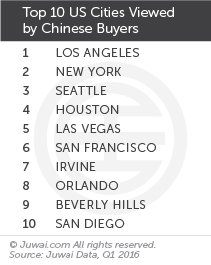
    A 70% share of these investments flowed hard and fast into New York, Los Angeles and San Francisco and the EB-5 programme has generated USD 11 billion from Chinese over the last 25 years. In other words, this nation is responsible for 70% of all funds to ever enter the scheme as well as the creation of 200,000 American jobs. Furthermore, the total investment volume for American commercial property could top USD 58 billion by 2020 according to the Asia Group. Chinese investors are clearly too eager to get their funds off the mainland with very good reason.

    Some basic economics

    Some structural economic changes, both good and bad, are forcing capital out of China. Analysts believe these are long-term changes, meaning that the money flood will continue. China’s economy has significantly slowed after years of stable double-digit growth. In 2015, it only grew by 6.9%, which is the lowest growth rate of the last 25 years. In fact, the economy expanded by just 1.1% in Q1 2016 year-on-year according to data from the National Bureau of Statistics.

    Specifically, it is the yuan (RMB) devaluation that has distinguished itself as one of the biggest drivers behind the current capital outflow. During the period from August 2015 to May 2016, the national currency lost nearly 5% against the dollar and the future is still far from secure, so affluent Chinese are still actively seeking out foreign economies as safe havens for their capital.

    Volatility on the Shanghai Stock Exchange (SSE) reflects the economic turmoil and the instability is encouraging stakeholders to find more reliable assets elsewhere.

    These macroeconomic events are worsened by the country’s high rates of air pollution and other environmental problems as well as the constant threat of political repercussions from the government. For high net worth individuals (HNWIs) in China, countries like America, the UK and Australia are also attractive because of their renowned education systems and high living standards.

    New regulations on capital outflow

    Throughout China’s recent history, strict rules have regulated foreign investments but in November 2014, the government significantly loosened financial restrictions to stimulate its sluggish economy. In particular, they made it easier for citizens to buy assets abroad.  The legislative easing applied to both individual and institutional investors, like insurance companies, in order to encourage better integration of the national financial system into the global one. By doing so, the yuan started to be used more around the world, which in turn, stimulated overseas real estate purchases.

    Since 2012, insurance companies are permitted to have up to 15% of their assets tied up abroad, while individuals have a right to move out USD 50,000 overseas annually. However, the rules have been largely ignored and the system is notoriously “leaky” with money exiting the mainland into places like Hong Kong and Macau. In response, Chinese officials recently announced that they will step up vigilance over illegal capital outflows into insurance products in Hong Kong.

    Mega-rich in the Middle Kingdom

    China has the biggest population on Earth (1.38 billion) and has been enjoying a couple of very successful decades. So, naturally, it became home to one of the largest populations of HNWIs in the world. The latter are defined as individuals with over USD 1 million in financial assets.

    According to a Hurun Research Institute report, in 2015 China had the biggest population of billionaires, beating the U.S. The country now is home to 568 billionaires compared to 535 in America. Even though this Beijing-based research clashes with Forbes findings (only 335 Chinese billionaires in 2016), the trend is clear: the Middle Kingdom’s ultra-rich population has risen sharply over recent years, growing by as much as 80% since 2013.

    Real estate is by far the biggest producer of billionaires in the Middle Kingdom (20.6%), followed by manufacturing (16.5%) and technology (12%), meaning that these investors have a good and often professional understanding of the market.

    China also had just less than 1.1 million people with assets exceeding RMB 10 million (about USD 1.5 million) in 2013. By 2016, their population had grown to over 1.2 million. The millionaires fall into four categories: private business owners, professional stock market investors, real estate investors and highly paid top managers.

    What are their investment aims?

    According to Juwai.com, there are four drivers behind their eagerness to own property abroad: investment and education, followed by lifestyle (including environmental concerns) and emigration. The National Association of Realtors (NAR) in the U.S. echoes these findings. As many as 30% of China’s millionaires prefer sending their children abroad to get educated so as to have better opportunities when they are adults. Furthermore, a Goldman Sachs report also highlights the crackdown on corruption as one of the strong drivers of capital outflow and emigration.

    Top five countries for Chinese investments are all English speaking

    The situation is also encouraged by local laws: the Chinese state has full rights to land leased to individuals or businesses, with the maximal term of 70 years. By doing so, investors have no guarantees that they can hold onto the land after the leasehold expires. Unlike China, developed countries hand over land for keeps and provide attractive returns on capital invested compared to low yields on the Chinese market, which is oversupplied in all real estate segments.

    What next for Chinese investors?

    Chinese citizens are likely to stay the largest and fastest-growing group of international property buyers. The report published by Asia Society and Rosen Consulting Group forecasts overseas real estate investments to reach USD 218 billion between 2015 and 2020. However, as countries modify investment visa schemes (the EB-5 is under fire in the U.S.) and popular property markets heat up, buying patterns will likely evolve. As per a recent Cushman & Wakefield report: “Reflecting their desire to grow holdings we see investment spreading to a broader range of geographies and assets as well as increased development.”

    Some interesting facts 

    More than half of Chinese millionaires’ money and 66% of billionaires’ is invested in property.

    China’s rich and mega-rich are 38 to 40 years old on average, health-conscious and obsessed with protecting their assets.

  • www.Buy2Greece.com – Domain and Facebook Launch Advertising Solution

    Australian real estate website Domain’ has partnered with Facebook to deliver real estate agents with  ‘Social Boost’ a product to sell properties faster using increased reach, exposure and interest.

    The new offering is a targeted social advertising solution that gives agents access to Domain’s unique search insights and Facebook’s highly engaged audience of 14 million in Australia.

    Domain says Social Boost will amplify agents’ exposure through a more targeted social media campaign, improved lead generation, more engaging ad display and the ability to generate unique word of mouth interactions through social sharing.

    Social Boost will showcase an agent listing as a Domain sponsored post on Facebook, the company explains.

    Facebook Australia Head of eCommerce Melinda Petrunoff says Domain’s Social Boost is taking real estate marketing to a whole new level.

    “Domain’s search insights and Facebook’s ability to target real people means that estate agents can now promote the right properties to prospective buyers among the 14 million Australians on Facebook,” Petrunoff says.

    “Social Boost provides a unique level of targeting property advertising, promoting the relevant properties to the right potential buyers.”

    Morton Real Estate is one of the first groups in Australia to use Social Boost and has already achieved strong results.

    Marketing Manager Sarah Fowl says having Social Boost on the company’s listing has really helped increase exposure, resulting in more inbound enquiries to the property.

    “Social Boost is a fantastic product that we are excited to pitch to our vendors moving forward,” Fowl says.

    Domain’s Social Boost is currently available to agents in NSW, QLD metro, VIC metro, WA metro and will be rolled out to the rest of Australia later this year.

  • Buy2Greece.com – Travel industry and travelers has collective responsibility for safe air travel

    Two hearings took place on Capitol Hill to address the increasingly long lines and security issues currently facing U.S. airports.

    Transportation Security Administration (TSA) Administrator Peter Neffenger testified before the House Committee on Homeland Security on his plans to deal with the challenges at TSA. The House Homeland Security Committee’s Transportation Security subcommittee heard from local officials serving on the front lines at airports, airlines and aviation executives on the frustratingly long security lines.

    Michael W. McCormick, Executive Director and COO of the Global Business Travel Association (GBTA) – the voice of the business travel industry – issued the following statement in which he called on TSA, Congress and the industry to work together in a collective effort to fix the current state of airport security, ensuring safe and efficient air travel:

    “For several months, GBTA has been warning its members of tighter airport security and increasingly long security lines that would not necessarily bring added security. The devastation we saw in Brussels underscores the fact that forcing people to queue up in long lines to go through security could actually be setting up soft targets for terrorists.

    But we are far beyond the time for finger pointing. Congress, the TSA, the travel industry and travelers themselves must come together as we embark on the busy summer travel season.

    It is well known that TSA is understaffed. But the agency must do a better job of utilizing the staff available and to better manage its resources. Local TSA officials need the flexibility and agility to manage security lines hour by hour. And TSA headquarters needs to ensure the officers on the ground have the intelligence and planning abilities to address security threats.

    For their part, airports and airlines deserve credit for taking proactive steps to manage queues and for hiring contractors to help assist TSA personnel with non-screening functions.

    Finally, travelers must be cognizant of the strain on the system and do everything in their power to help move travel along. Every frequent traveler must enroll in PreCheck.

    As we work through the immediate crisis, TSA must begin to develop long-term solutions. GBTA strongly believes in risk-based programs and supports ways to expand enrollment in TSA’s PreCheck program. The House and Senate have both embraced this plan, but the different vehicles for passage are being held up. GBTA has called on Congress to include this language in the FAA Reauthorization and to pass it without further delay.

    TSA, Congress and the air travel industry must address this as an all-hands-on-deck response as we all need to share the responsibility of supporting the efforts necessary to protect one of our nation’s most valued assets: safe and secure air travel.”

  • www.Buy2Greece.com – Travel industry and travelers has collective responsibility for safe air travel

    Two hearings took place on Capitol Hill to address the increasingly long lines and security issues currently facing U.S. airports.

    Transportation Security Administration (TSA) Administrator Peter Neffenger testified before the House Committee on Homeland Security on his plans to deal with the challenges at TSA. The House Homeland Security Committee’s Transportation Security subcommittee heard from local officials serving on the front lines at airports, airlines and aviation executives on the frustratingly long security lines.

    Michael W. McCormick, Executive Director and COO of the Global Business Travel Association (GBTA) – the voice of the business travel industry – issued the following statement in which he called on TSA, Congress and the industry to work together in a collective effort to fix the current state of airport security, ensuring safe and efficient air travel:

    “For several months, GBTA has been warning its members of tighter airport security and increasingly long security lines that would not necessarily bring added security. The devastation we saw in Brussels underscores the fact that forcing people to queue up in long lines to go through security could actually be setting up soft targets for terrorists.

    But we are far beyond the time for finger pointing. Congress, the TSA, the travel industry and travelers themselves must come together as we embark on the busy summer travel season.

    It is well known that TSA is understaffed. But the agency must do a better job of utilizing the staff available and to better manage its resources. Local TSA officials need the flexibility and agility to manage security lines hour by hour. And TSA headquarters needs to ensure the officers on the ground have the intelligence and planning abilities to address security threats.

    For their part, airports and airlines deserve credit for taking proactive steps to manage queues and for hiring contractors to help assist TSA personnel with non-screening functions.

    Finally, travelers must be cognizant of the strain on the system and do everything in their power to help move travel along. Every frequent traveler must enroll in PreCheck.

    As we work through the immediate crisis, TSA must begin to develop long-term solutions. GBTA strongly believes in risk-based programs and supports ways to expand enrollment in TSA’s PreCheck program. The House and Senate have both embraced this plan, but the different vehicles for passage are being held up. GBTA has called on Congress to include this language in the FAA Reauthorization and to pass it without further delay.

    TSA, Congress and the air travel industry must address this as an all-hands-on-deck response as we all need to share the responsibility of supporting the efforts necessary to protect one of our nation’s most valued assets: safe and secure air travel.”

  • www.Buy2Greece.com – US warning of Europe attacks trigger fall in European tourism-related shares

    The US issued a travel alert over the possibility of attacks in Europe this summer causing ripples in the travel sector and the plunging of European tourism-related shares.
    The travel and leisure sector fell 1.5 per cent, among top sectoral fallers.
    In the warning, the US specified that major events, tourist sites, restaurants, commercial centers and transportation could all be targeted.
    The already battered French tourism industry had to face another downfall with the fall in shares of French tourism stocks.
    “The expectation is that we will see a bit of a difficult summer, and the backdrop of that perception of an increased risk of attacks is certainly not helping,” Chris Beauchamp, market analyst at IG, said.

  • www.Buy2Greece.com – Ryanair Cuts Bag Fees For 92% of Customers

    Ryanair, Europe’s favourite airline, today (2 Jun) cut its checked-in bag fees for 92% of its 116m customers, and simplified the number of bag fee options (from 108 to 6), as part of Year 3 of its “Always Getting Better” (AGB) programme, which continues to improve the customer experience, through service, digital and inflight developments.

    From today, customers on domestic flights under 2 hours will have their bag fees cut by 50%, while customers on all other flights under 3 hours will enjoy savings of up to 17%. Customers on flights over 3 hours will see no change to their checked bag fees.

        15kg Bag 20kg Bag
    Flight % Customers Was            Now       Saving Was           Now        Saving
    Dom. Flights < 2hrs 18% £30             £15        50% £40            £25         38%
    Flights < 3hrs 74% £30             £25        17% £40            £35         13%
    Flights > 3hrs 8% £40             £40         N/A £50            £50         N/A


    Ryanair’s Chief Marketing Officer, Kenny Jacobs said:

    “We’re pleased to cut bag fees for 92% of customers as part of our “Always Getting Better” programme with a streamlined range of just 6 bag fee options, as we continue to listen to our customers and improve the Ryanair experience for the 116m people we’ll carry this year.

    Over 92% of our customers will enjoy reduced bag fees and will pay the same price for checking-in a bag whether bought at the time of the initial booking or added to the booking, regardless of seasonality. Furthermore, customers will also be able to add bags to their bookings via the Ryanair app up to 3 hours before their scheduled time of departure.

    These bag changes are in addition to our best-in-class cabin bag allowance, offering 2 free carry-on bags, and we’ll continue to offer the biggest and best choice of destinations, with the most on-time flights and a fantastic onboard experience, as we grow our fleet, traffic and routes – and all on the lowest fares.”


  • www.Buy2Greece.com – Lufthansa is honoured with German Aviation innovation prize

    At the opening of the International Aerospace Exhibition (ILA) in Berlin on 31 May, Lufthansa was honoured with the innovation award from the German Aviation Industry in the category of emissions reduction. The innovation award is presented under the patronage of the German Federal Ministry of Economy and Energy (BMWi) and is aimed at companies, start-ups and individuals who have facilitated innovations in the field of civil aviation.

    The award recognises the newly developed analysis software OMEGA, which was developed together with the IT company Aviaso. The name stands for ‘Ops Monitor and Efficiency Gap Analyzer’. The IT programme uses data collected from flight operations to improve the efficiency of future flights. Amongst other things, weather, flight performance and navigation data are evaluated. After around three years of its project phase, it was successfully put into regular operation at the end of 2015.

    The new software programme provides important data by comparing the planned, actual and optimum values during the different phases of flight in order to reduce fuel and CO2 emissions. “We have taken a great step forward with project OMEGA: Now we can evaluate the experience gained from thousands of daily flights worldwide. And with it, we can optimise flight planning and therefore save several thousand tonnes of kerosene per year. This is a significant contribution to the improvement of the ecological balance”, says Dr. Joachim Schneider, Vice President of Flight Operations Standards & Projects, Deutsche Lufthansa. Pilots can take advantage of the analyses carried out in order to optimally prepare during the flight and for its arrival destination, and also use it to detect any possible deviations from the plan at an early stage.

    In 2008, the Lufthansa Group published their strategic environmental programme. Since then, the Group has managed to improve the fuel efficiency of the passenger fleet by 11.5 percent to 3.84 litres per passenger and 100 kilometres in 2015.

  • www.Buy2Greece.com – 10 most popular summer destination for Russian tourists

    Visa-free policies of a number of countries have increased the demand for holidays among Russian tourists in these countries.

     Russia’s Federal Agency for Tourism (Rosturizm) reveals the ten most popular destinations for Russian tourists which are Greece, Cyprus, Tunisia, Russia, Bulgaria, Thailand, Spain, Vietnam, Montenegro, and Italy, Fed.sibnovosti.ru reported.

    “The demand for holidays in these countries is due to the possibilities for visa-free visits to a number of the countries in question as well as the democratic price policy,” Sergey Agafonov, chair of the Union of Travel Agencies in Russia, said.

    The interest shown by Russian tourists in Cyprus has doubled while that shown in Montenegro has increased by 37%.
    The popularity of resorts in Russia, Bulgaria, Thailand, and Vietnam has increased by 60%.