Ξεκινάμε τον Απρίλιο του 2020 με αισιοδοξία για το μέλλον και την ελπίδα οτι οι δυσκολίες που μας επιφύλαξε ο προηγούμενος μήνας, σύντομα θα είναι μια ανάμνηση. 
Σας ευχόμαστε ΚΑΛΟ ΠΑΣΧΑ με υγεία & αισιοδοξία!
BUY2GREECE TEAM
Ξεκινάμε τον Απρίλιο του 2020 με αισιοδοξία για το μέλλον και την ελπίδα οτι οι δυσκολίες που μας επιφύλαξε ο προηγούμενος μήνας, σύντομα θα είναι μια ανάμνηση.
Σας ευχόμαστε ΚΑΛΟ ΠΑΣΧΑ με υγεία & αισιοδοξία!
BUY2GREECE TEAM
 A massive earthquake of 6.7 magnitude has hit the coastal areas of Turkey and Greece, leaving more than 200 injured and killing two.
The earthquake struck near major tourist destinations around the Aegean sea in the early hours of Friday. The quake has hit south of the Turkish city of Bodrum and east of the Greek island of Kos where more than 120 people were injured and seventy more were injured in Turkey.
The United States Geological Survey (USGS) said it was a very shallow quake – only 10km below the seabed off the southwestern coastal city of Marmaris in the Mugla province. The epicentre of the earthquake was just 10km south of the Turkish resort of Bodrum and 16km east-northeast of Kos.
The Turkish towns of Bodrum and Datca, and Kos in the Dodecanese Islands archipelago are all major tourist destinations in these two countries. As it is the best time to visit, there were more than 8000 British holidaymakers in Kos when the earthquake struck.
George Kyritsis, the mayor of Kos told that at least two people were killed on the Greek island and several were injured by the quake. He later added that the two dead were foreigners.
A hospital official said that the 2 foreigners were killed when the ceiling of a building collapsed. The emergency services said the affected area was a bar in the centre of Kos tow.
The port was among structures that sustained the damage and a ferry en route there was not docking, the coast guard said. The fire service of Greece said it had rescued three injured persons from a damaged building.
The Chairman of Disaster and Emergency Management Presidency of Turkey (AFAD), Mehmet Halis Bilden, warned the citizens of these two countries about incoming aftershocks. The citizens need to know about the disaster and they need to know about the repeated aftershocks.
Disaster and Emergency Management Presidency of Turkey said it had observed at least 20 aftershocks in Turkey and Greece following the main shock at 1.31am local time on Friday (22.31 GMT on Thursday). At least five of the aftershocks registered over 4.0 magnitude, with the largest so far at 4.6. A magnitude 6.7 quake is considered strong and is capable of causing considerable damage, but the effects of this one would have been lessened by striking in the sea. The European quake agency EMSC said a small tsunami could be caused by the quake, but Turkish broadcasters cited officials saying large waves were more likely.
In April, leaked documents from an American Hotel and Lodging Association board meetingrevealed a detailed national campaign to curb the growth of the short-term rental industry. Miami, one of the top cities in the country for Airbnb, was listed as a critical market.
Also mentioned in the five-page document was Florida International University, one of four universities in the country working on research the association planned to use in its anti-Airbnb campaign. According to the memo, FIU’s research on safety and security in the hospitality industry would “support our fundamental argument about the harms that short-term rental companies pose to consumers and communities, and provide data to buttress testimonial campaign.”
Meanwhile, Airbnb was working on a campaign of its own, funding a watchdog blog, the Checks and Balances Project, beginning in October 2016 to investigate the hotel industry’s campaign against home sharing (Airbnb would not say how much it gives the blog in funding). “New documents raise question of what role hotel lobby’s chair played in Penn State pay-to-play scheme,” a recent blog entry headline reads, referring to a pair of Pennsylvania State University studies funded by the hotel association about the growth of full-time short-term rental operators.
THIS RESEARCH WILL SUPPORT OUR FUNDAMENTAL ARGUMENT ABOUT THE HARMS THAT SHORT-TERM RENTAL COMPANIES POSE TO CONSUMERS AND COMMUNITIES, AND PROVIDE DATA TO BUTTRESS TESTIMONIAL CAMPAIGN.
Leaked American Hotel and Lodging Association memo
Most recently, the Checks and Balances Project turned its focus to the other schools on the hotel association’s list — Rutgers University, the University of North Carolina and FIU — requesting information on their proposed studies.
At FIU, the result was a public document containing the executive summary for assistant director Eric Beckman’s upcoming short-term rental research, funded via a grant from the American Hotel & Lodging Education Foundation for $68,209.50.
How could the university’s research be unbiased when it was paid for by the hotel industry, the blog questioned when it approached the Herald about its own findings. What the watchdog group didn’t say: its own research was paid for by the home sharing industry.
SINCE OCTOBER 2016, AIRBNB HAS BEEN FUNDING A WATCHDOG BLOG, THE CHECKS AND BALANCES PROJECT, TO INVESTIGATE THE HOTEL INDUSTRY’S CAMPAIGN AGAINST HOME SHARING.
It’s yet another illustration of the tension between the two competing industries. Although publicly each often says the greater hospitality business has room for both, behind the scenes they often go to great lengths to discredit their opponent.
In Miami-Dade County, the battle around the growth of Airbnb and similar platforms has been playing out for more than year, since Miami Beach imposed $20,000 fines on illegal short-term rental hosts. Miami then banned renting on platforms like Airbnb in suburban areas.
But the FIU study, as the Penn State studies before it, will likely thrust home sharing into the national spotlight again — bringing a new kind of Airbnb battle to South Florida. \
FIU professor Beckman said the short-term rental report was the university’s idea.
His executive summary calls for a study that determines “if there are any gaps in the perceived and real-life safety-security of short-term rentals and hotels through a content analysis and a survey of the general public.” (The full proposal is confidential, FIU said. Its original proposal was denied by the hotel association because it didn’t have a “well-defined scope;” it was then amended, according to AHLA.)
Beckman, who teaches at FIU’s Chaplin School of Hospitality and Tourism Management, said he expects to finish the research by September or October. The study will survey residents in a handful of cities, including Miami and Nashville, about their perceptions of safety and security at hotels and short-term rentals.
$68,209.50Cost of a grant to FIU from the American Hotel and Lodging Associaion for a study on safety and security in the hospitality industry
According to the hotel association’s abstract of the project, residents will be surveyed in face-to-face interviews or email questionnaires. They also will be asked what security and safety features are most important to them. The study will provide recommendations on guest safety, but neither the executive summary nor the abstract call for measurement of actual safety records.
Under law, hotels have to abide by a laundry list of safety regulations, including fire codes and ADA guidelines, but short-term rentals don’t. A proposed ordinance for unincorporated Miami-Dade may impose some regulation on rentals, including screening potential guests for sexual predators, regulations Airbnb said it agrees to.
Beckman said he has not been in communication with the hotel association and has not yet been paid for the study, although FIU said it expects to be funded, according to public documents. The grant for the report was issued in March.
Asked how he will remain independent when the hotel association expects a certain outcome from his research, Beckman said, “that’s a challenge, but it’s one that we are willing to meet and we are willing to address.”
WE GO OUT OF OUR WAY AT THE UNIVERSITY LEVEL TO BE UNBIASED AND WE LOOK THROUGH THE LENS OF HOW CAN WE HELP CONSUMERS.
Eric Beckman, FIU associate professor
“We go out of our way at the university level to be unbiased and we look through the lens of how can we help consumers,” Beckman added.
The hotel association said an independent committee reviews grant proposals, and that researchers are not required to share information on the study prior to its publication. Still, according to the leaked memo, AHLA expects the short-term rental studies it funds to “drive earned media” and build on the Penn State reports.
Scott Peterson, executive director of Checks and Balances Project, questioned how independent the school will be able to remain.
“We know that industry-funded research can often lead to biased conclusions,” Peterson said in a statement. “Will AHLA get what they seem to expect for their $70,000? FIU should condemn the hotel lobby’s attempt to manipulate a respected academic institution.”
YOU WILL SEE THE STUDY WHEN WE SEE THE STUDY.
Rosanna Maietta, AHLA spokeswoman
The association agreed to fund FIU’s study because it strongly believes the research will show short-term rentals are not safe — but not because it’s manipulating the data, said AHLA spokeswoman Rosanna Maietta.
“When we put [the five-page board memo] together, it was to let our board know what research is out there,” Maietta said. “It’s simply to say that we know this is an issue and there is a study going to be conducted to quantify what is actually happening.”
“You will see the study when we see the study,” she said.
Chabeli Herrera: 305-376-3730, @ChabeliH
Dear colleagues,
We are glad to present you Kyiv Internation Property Show 2017 – a private high-class event in one of the most prestigious hotels in Kyiv.
(Ukraine)
TripAdvisor® the world’s largest travel site* from reviews to bookings, today announced the winners of its Travellers’ Choice®awards for Landmarks. Award winners were determined using an algorithm that took into account the quantity and quality of reviews and ratings for landmarks worldwide, gathered over a 12-month period. The awards honor 706 landmarks in 82 countries.
Top 10 Travellers’ Choice Landmarks – India
1. TajMahal – Agra, Uttar Pradesh
2. AmberFort – Jaipur, Rajasthan
3. SwaminarayanAkshardham – New Delhi, National Capital Territory of India
4. BandraWorli Sea Link– Mumbai, Maharashtra
5. QutabMinar– New Delhi, National Capital Region of India
6. AgraFort – Agra, Uttar Pradesh
7. HarmandirSahib(Golden Temple) – Amritsar, Punjab
8. Humayun’s Tomb – New Delhi, National Capital Region of India
9. Gateway of India – Mumbai
10. MehrangarhFort – Jodhpur, Rajasthan
“India has many incredible landmarks and payinga visit to them is a fantastic way to get acquainted with the country’s rich history. With summer being the peak travel season owing to the summer vacations, the TripAdvisor Travellers’ Choice Landmarks list will help Indian travellers narrow down the attractions to visit during their trip whether in India or abroad” said Nikhil Ganju, Country Manager, TripAdvisor India.
Top 10 Landmarks in India:
1. TajMahal – Agra, Uttar Pradesh
Popular as the epitome of love, Taj Mahal is undisputedly one of the most iconic wonders in the world. Year after year it attracts an increasing number of tourists from all across the globe. A TripAdvisor traveller commented “Words can’t really explain how amazing this place is”.
2. AmberFort – Jaipur, Rajasthan
A blend of Mughal and Rajput architecture, Amber fort is one of the top tourist attractions in Jaipur. The Sheesh Mahal a state room in the fort also known as the mirror palace is world famous for thousands of mirror tiles which are said to be lit using a single candle. “This is one of the best forts of the world according to its design Vastu and safety and security features as well as internal and external beauty” is how a TripAdvisor traveller described this landmark.
3.SwaminarayanAkshardham – New Delhi, National Capital Region of India
Spread across a 100 acres in Delhi, Swaminarayan Akshardham is a visual delightand fills one with spirituality and culture. Built on the banks of River Yamuna, the temple showcases architectural styles from all over India. A TripAdvisor traveller commented “This is an absolute highlight in Delhi. Its architecture is impressive, both inside and out”.
4. BandraWorli Sea Link– Mumbai
The BandraWorli Sea Link connects Bandra, located in the western suburbs of Mumbai to Worli in South Mumbai. This 5.6km structure across the Arabian Sea is an architectural marvel and considered to be one of the biggest cable-stayed bridges in the world. “Great view and driving experience. Is a pleasure for driving enthusiasts” is how a TripAdvisor traveller describes his experience.
5. QutabMinar– New Delhi, National Capital Region of India
Considered an epitome of victory, Qutab Minar is an architectural delight and a must visit monument in Delhi. Its 5 storied 73 meter tall tower is built with red marble. “An amazing piece of Indian history” commented a TripAdvisor traveller.
Source:-Tripadvisor
Research by international luxury travel network Virtuoso® has uncovered the five factors shared by its top-producing agencies that can serve as a model for others to improve profitability.
Virtuoso identified the 25 agencies with the highest production per advisor, a metric that established a baseline that can be applied to all agency members regardless of size, then examined the characteristics they have in common with each other. The network unveiled the analysis at its annual Symposium held this year in Vancouver, British Columbia, with 530 of luxury travel’s most prominent figures in attendance.
The common qualities of Virtuoso’s top 25 agencies:
After Virtuoso delved deeper by interviewing executives at the top 25 agencies, an important pattern of behaviour emerged. Although a collection of great advisors is key, agency excellence extends beyond that. What transports an agency from good to great is creating a specific strategy and ensuring that it is reflected in all its actions.
The five secrets of success for Virtuoso’s top 25 agencies:
This year’s study offers a fresh direction on a related theme to last year’s research revealed at Symposium, which examined the seven habits of highly successful advisors. Virtuoso encourages all its member agencies to review the high bar set by these top performers and adopt their strategic secrets of success to attract more clients and increase profitability. Since travel agencies are a critical driver of industry sales, the health of agencies serves as a barometer for the entire travel ecosystem.
It seems global accommodation site Airbnb is consistently launching new products, so it’s no surprise to hear they’ve got another one on the go: a search tool for business travellers.
This feature will launch soon and allow professionals to filter homes and apartments that Airbnb has deemed Business Travel Ready, reports Bloomberg. To qualify for a BTR listing, as the company calls it, the dwelling must have a desk, Wi-Fi, self-check-in through a doorman or digital lock and various amenities you’d expect at a hotel, like free shampoo, a hairdryer and iron.
Last year Airbnb announced the introduction of its Trips feature, which includes guided nights out and experiences such as violin making in Paris and marathon running in Kenya. The company continue to expand its offerings and this new tool is just another example of how.
There were 250 companies signed up with Airbnb to book and manage business travel in 2015. Last year, the number of people using the site for business purposes tripled and is expected to quadruple this year, said David Holyoke, the head of Airbnb’s business travel division. There are now more than 250,000 companies using it, including Alphabet Inc., Domino’s Pizza Inc. and Morgan Stanley.
Berkshire Hathaway HomeServices said it entered a marketing agreement with Juwai.com to attract wealthy Chinese buyers looking to purchase homes in the United States. The brokerage said the agreement will make it “much easier” for the 2 million monthly users of Juwai.com and Juwai.com/luxe to browse franchisees’ residential listings the Chief Executive of HomeServices Gino Blefari said in a statement.
Charles Pittar, CEO of Juwai.com, said the agreement between the Chinese portal and HomeServices would be beneficial for the Chinese property market.

“Because of its amazing success and transparency over the years, Berkshire Hathaway is a name that Chinese consumers trust,” Pittar said. “We expect them to respond very well to having the Berkshire Hathaway HomeServices brand, its listings, and its agents on Juwai.com.
“When Chinese families are making a decision as important as buying overseas property, they want to know they are working with people they can trust,” Pittar
Airbnb has estimated it will earn as much as $3.5 billion a year by 2020 (before interest and taxes and depreciation) according to sources close to the company, reports Fortune.
This figure would also be a 3,400% increase from what the company had in similar profits last year, based on numbers provided by those sources.
The bottom line growth would be a huge achievement for the home and apartment sharing company that just a few years ago was among a number of so-called Unicorns that seemed to have a lot of potential, but not much in the way of profits. It would also make Airbnb the first company to prove that the so-called sharing economy can be turned into sustainable success. That’s something that Uber, the sector’s other superstar, has yet to prove.
The amount of profit the company is due to make has been reported by a source familiar with the company’s internal estimates, and hasn’t previously been made public, though Bloomberg previously reported the company turned its first profit in 2016.
That’s an increase of 175 million from the current count of 165 million Chinese retirees1 – a figure that not only exceeds the current population of the US2, but also makes them an emerging force in global property markets that will amount to one of the world’s largest consumer base.
More importantly, this massive market of China’s silver generation has equally substantial funds at their disposal.
Older Chinese are sitting on a hefty share of the $2.4 trillion in savings3 planted in China’s banks4, having lived through China’s boom years, benefited from rising incomes, and capitalised on China’s fast-growing property markets.
Already, their wealth is already impacting global property markets, albeit indirectly. Chinese insurers, custodians of billions of RMB in retirees’ pension and insurance plans, are steadily channelling their cash piles into global property markets, investing $3.1 billion in overseas real estate in H1 20165, and with a further $73 billion expected to follow by 2019.6
China’s silver generation more globally savvy and discerning
Aside from insurers, individual retirees – or those planning for future retirement – are now becoming much more active in global property markets, in part because their horizons are broadening.
The waves of outbound tourists from China, which numbered 120 million in 2015 and is projected to hit 139.2 million this year, are becoming more globally savvy as they get to know more countries around the world, and older generations are well and truly part of this outbound trend.
The China Outbound Tourism Institute estimates tourists aged 60+ accounted for 5 million trips in 20157 and China Britain Business Council estimating a US$34 billion potential spend from this age group.8
In fact, another recent Citi report revealed that outbound tourism by Chinese elderly have skyrocketed as much 217% last year alone.9
Increased awareness of overseas opportunities gives retirees more options to build an overseas lifestyle as well.
57% of Chinese high net worth individuals (HNWIs) prefer to retire in a home of their own, in preference to care homes.10
This is because times are changing, and no longer are China’s rich and wealthy completely adhering to the Confucian ethic of filial piety, whereby Chinese children take care of their elderly parents when they are unable to care for themselves.
Instead, Chinese HNWIs are now in pursuit of independence after retirement, an option that came about due to a growing awareness of the pressures placed upon their children – most who are a single child born under the one-child policy – as well as a desire to not burden them, if possible.11
And for this silver generation, ‘independence after retirement’ translates into living away from their children as they search for relaxed and enriching lifestyles that come hand-in-hand with plenty of travelling around.
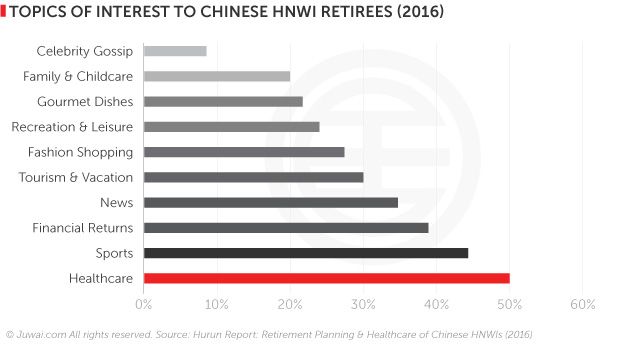
That said, with China’s dubious environmental quality, many Chinese retirees are on the lookout for an overseas property with access to both top quality medical care and attractive living environments while jet-setting around the world.
In fact, Chinese spent $10 billion on medical tourism in 2015 alone, of which Chinese retirees are an important part of this market – and it’s this growing market that is helping to spur property investment in destinations famed for medical treatments, such as in the US.
50% of China’s HNWIs cited healthcare as their primary concern and main topic of interest for 2016.10
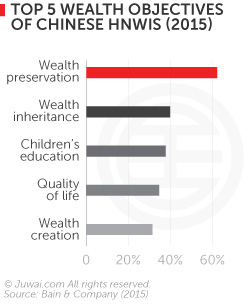 Asides from lifestyle concerns, Chinese retirees are also generational investors who also want to ensure that they are providing for the next generation.
According to research from Bain & Company, Chinese high net worth individuals factored inheritance, children’s education, and life quality as three of their top five wealth objectives.12
With this in mind, an overseas property in a suitable location not only offers a Chinese retiree a unique opportunity to meet their lifestyle aspirations, but also provides both a springboard for their children and grandchildren to enjoy overseas educational opportunities, as well as securing a high-value asset which they can pass on to the next generation.
Connectivity, easier visas, and better pension access broadening retirees’ horizons
Even as Chinese mentality is changing, so is the world to make it easier than ever for Chinese retirees to seek an overseas retirement.
Today, China has become more closely connected with the world, driving what Boeing expects will be a 3x increase in total passengers travelling between China and the US alone by 2021.13
This factor, together with expanding international transport links from China’s lower-tier capitals, will open up many more opportunities for travel, and make it more feasible for retirees to split time between bases at home and overseas.
Countries all over the world are opening their doors to Chinese investors too. Recent moves by Singapore, Australia, the UK, and the US to increase multiple entry visa validity for up to 10 years – plus the raft of ‘golden visa’ residency programs offered by locations such as Portugal, Spain and Greece – all mean that Chinese retirees are now spoilt for choice when it comes to choosing overseas retirement locations.
Interestingly, China’s government is making it easier than ever before for retired Chinese residents living overseas to claim their pensions as well.14 Previously, a convoluted claim procedure meant that many overseas-based Chinese retirees gave up seeking their pensions. However, this policy change now recognises their overseas status, thus giving them greater confidence in supporting themselves overseas.
A greying economy but a golden opportunity
Powerful demographic trends, an increasingly outward looking customer base, and improving links between China and the outside world are aligning to create a high-potential market of Chinese retirees looking abroad for property.
Furthermore, Chinese retirees have money to spend – China’s state-run Research Centre on Ageing forecasts total expenditure by Chinese retirees to reach RMB1 trillion by 2050.15
So agents, it’s time you tailor your offerings to suit China’s older generation. Here are three ways how:
Chances are, strategies like these can win you interest, trust, and completed deals from China’s retirement-minded property investors, so good luck with your promotions, and here’s to a golden return from China’s greying economy.
Sources: 1. Brookings Institute: China’s one-child policy at 30; 2. US News: US population in 2015; 3. Naked Capitalism: The puzzle of China’s rising household saving rate; 4. Wikipedia: List of countries by GDP; 5. Fortune: Why Chinese investment in overseas real estate has more than doubled; 6. SCMP: The Chinese are coming: Insurers expected to pour US$73b into overseas properties; 7. COTRI: Elderly Chinese, a market segment of increasing importance; 8. China-Britain Business Council: China’s silver consumers; 9. Citi Report on SCMP: Goodbye tour buses and loud hailers: Chinese tourists now choosing the more personal approach; 10. Hurun Report: Retirement Planning & Healthcare of Chinese HNWIs 2016; 11. Jing Daily: China’s rich opt for luxury nursing homes over filial obligations for aging parents; 12. Bain & Company/China Merchants Bank: China Private Wealth Report; 13. Boeing: Current Market Outlook: 2015-2034; 14. China Daily: Simplified process helps Chinese retirees in US get pensions from overseas; 15. SCMP: Navigating through China’s grey economy
 Buy2Greece.com