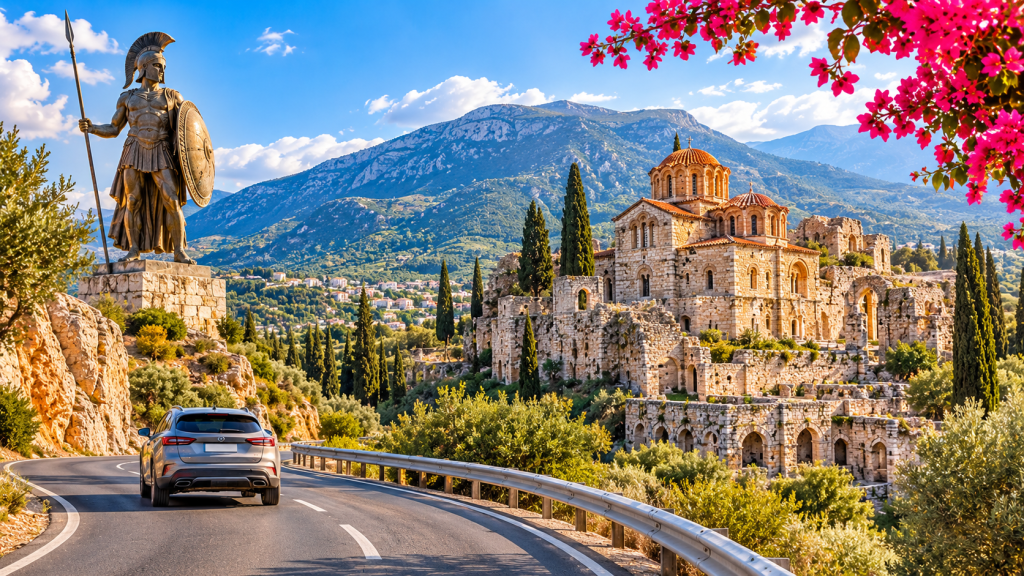
Greece is a country where history and natural beauty come together, and few regions demonstrate this combination better than the Peloponnese. From ancient archaeological sites and medieval castles to picturesque mountain villages and traditional seaside towns, this part of mainland Greece offers countless opportunities for exploration.
One of the most rewarding journeys you can take is a road trip from Athens to Sparta and Mystras. Located in the heart of Laconia, these two destinations represent different but equally fascinating chapters of Greek history. Sparta is internationally known for its legendary warriors and ancient military traditions, while Mystras preserves the remarkable architectural and cultural heritage of the Byzantine Empire.
The journey takes you through beautiful landscapes, traditional settlements, olive groves and mountain scenery, making it an ideal destination for a weekend escape or a longer holiday in southern Greece.
Whether you are interested in history, nature, gastronomy or discovering authentic Greek destinations, this road trip offers a memorable experience.
1. The Road from Athens to Sparta
The distance between Athens and Sparta is approximately 220 kilometres, and the journey usually takes between two and a half and three hours by car, depending on traffic and stops along the way.
The route follows the Olympia Odos motorway towards Corinth before connecting with the Moreas motorway, which continues south through the Peloponnese towards Tripoli and Sparta.
The roads are modern and generally easy to navigate, with several toll stations along the way. The journey itself is an opportunity to admire the changing scenery, from coastal landscapes and mountain ranges to green valleys and traditional agricultural communities.
One of the advantages of this route is that it allows travellers to combine several interesting destinations in a single trip.
A Stop at the Corinth Canal
Approximately one hour after leaving Athens, you will reach the impressive Corinth Canal.
This remarkable engineering achievement connects the Gulf of Corinth with the Saronic Gulf, separating the Peloponnese from mainland Greece. Its steep limestone walls create a spectacular view, making it one of the most popular photography stops along the route.
Even a short visit is worthwhile before continuing towards the mountains of the central Peloponnese.
Tripoli and Ancient Tegea
Further south, the motorway leads to Tripoli, the capital of Arcadia. The town is a convenient place to stop for coffee, enjoy a traditional breakfast or take a short walk around its central squares.
A few kilometres south lies the village of Alea, near the archaeological remains of Ancient Tegea.
Tegea was one of the most important ancient settlements in Arcadia and had a significant historical relationship with Sparta. Its most notable monument was the Temple of Athena Alea, which was renowned throughout the ancient Greek world for its architectural beauty.
Today, visitors can explore the archaeological remains and discover another fascinating aspect of the Peloponnese’s ancient past.
Entering the Beautiful Region of Laconia
As you continue south, the landscape gradually changes. The road descends through wooded hills until the fertile valley of the Evrotas River appears.
Olive trees and orange groves cover much of the countryside, while Mount Taygetos rises dramatically in the background. During winter and early spring, its highest peaks are often covered in snow, creating a striking contrast with the green valley below.
This scenic landscape marks the beginning of Laconia, one of the most historically significant regions of southern Greece.
2. Discovering Sparta: The Legendary City of Ancient Greece
Sparta is one of the most famous names in ancient history. Known for its disciplined warriors, military traditions and legendary figures such as King Leonidas, the ancient city played an important role in shaping the history of Greece.
Modern Sparta is a peaceful town with wide streets, green spaces and a relaxed atmosphere. Much of its present urban layout dates back to the 19th century, when the modern settlement was developed near the location of the ancient city.
The town is relatively easy to explore on foot, with several important attractions located close to the centre.
The Statue of Leonidas and the Ancient Acropolis
One of the first places visitors should explore is the statue of King Leonidas, located near the town’s stadium.
Leonidas became a symbol of courage and resistance after leading the Spartan forces during the Battle of Thermopylae in 480 BC.
Behind the statue, a pathway leads towards the remains of the Ancient Acropolis of Sparta. The archaeological site includes the ruins of temples, an ancient theatre dating largely to the Roman period and other remains that offer insight into the city’s long history.
Walking through this area provides an opportunity to understand the development of one of the most influential city-states of ancient Greece.
The Sanctuary of Artemis Orthia and the Menelaion
Another important archaeological site is the Sanctuary of Artemis Orthia, situated near the banks of the Evrotas River.
Dedicated to the goddess Artemis, the sanctuary was one of the most important religious centres of ancient Sparta. Archaeological findings reveal that it played a significant role in the religious and social life of the Spartan community.
Across the river, on a hill overlooking the valley, lies the Menelaion, an ancient sanctuary associated with Menelaus and Helen of Troy.
According to Greek mythology, their story began in Sparta, making the site particularly interesting for visitors fascinated by ancient legends and mythology.
The Museum of the Olive and Greek Olive Oil
A visit to Sparta would not be complete without discovering one of the region’s most important agricultural products: the olive.
The Museum of the Olive and Greek Olive Oil presents the history of olive cultivation and oil production in Greece, from prehistoric times to the modern era.
Through traditional tools, historical equipment and informative exhibitions, visitors can learn how olive oil became an essential part of Greek culture, cuisine and everyday life.
The Archaeological Museum of Sparta is another worthwhile stop, featuring sculptures, mosaics and artefacts discovered throughout the wider region.
3. Mystras: A Journey into the Byzantine Past
Just five kilometres west of Sparta lies Mystras, one of the most impressive historical destinations in the Peloponnese.
Built on the slopes of Mount Taygetos, this remarkable medieval settlement is recognised as a UNESCO World Heritage Site and offers a unique opportunity to explore the architecture and cultural heritage of the Byzantine Empire.
The history of Mystras began in 1249, when the Frankish prince William II of Villehardouin constructed a fortress on the hillside. The settlement later passed into Byzantine hands and gradually developed into an important political, cultural and intellectual centre.
During the 14th and 15th centuries, Mystras became the capital of the Byzantine territories in the Peloponnese, attracting scholars, artists and influential figures.
One of the most important historical events associated with the city was the proclamation of Constantine XI Palaiologos as Byzantine Emperor in 1449, just a few years before the fall of Constantinople.
What to See in Mystras
Today, Mystras is an extensive archaeological site featuring medieval streets, churches, monasteries, palaces and impressive defensive structures.
Some of the most important attractions include:
The Palace of the Despots
One of the most impressive buildings in Mystras, the Palace of the Despots served as the residence and administrative centre of the Byzantine rulers of the Peloponnese. Its architecture reflects the political importance and prosperity of the medieval city.
The Church of Agios Dimitrios
Also known as the Metropolis, this church was the religious centre of Mystras. Its architectural features and remarkable Byzantine decorations make it one of the site’s most important monuments.
The Peribleptos Monastery
Built into the natural rock formations of the hillside, the monastery is particularly famous for its Byzantine frescoes, which are considered outstanding examples of medieval religious art.
The Pantanassa Monastery
This beautiful monastery is still home to a small community of nuns. Its architecture, painted interiors and peaceful surroundings make it one of the most atmospheric places in Mystras.
The Castle of Mystras
Located at the highest point of the settlement, the castle offers spectacular views over the surrounding countryside, the Evrotas valley and the mountains of Laconia.
Practical Tips for Visiting Mystras
The archaeological site has two main entrances, one at the lower part of the hillside and another closer to the castle at the top.
Starting from the upper entrance and walking downhill is generally a more comfortable way to explore the area, as it reduces the amount of uphill climbing.
Visitors should allow at least three hours to explore the site properly. Comfortable walking shoes and drinking water are essential, particularly during the summer months.
During spring and autumn, the cooler weather makes exploring the archaeological complex especially enjoyable.
4. Experience Traditional Greek Culture in Sparta
Beyond its archaeological attractions, Sparta offers opportunities to discover traditional crafts and local cultural activities.
One particularly interesting experience is learning the art of mosaic-making.
Mosaics were an important form of artistic expression in ancient Greece and Rome, and numerous examples have been discovered in archaeological sites throughout the country.
In Sparta, visitors can participate in workshops where they learn how to create their own small mosaic using natural stone pieces and designs inspired by ancient artistic patterns.
It is a creative way to connect with the region’s history and take home a unique handmade souvenir.
5. Explore Beyond Sparta: Beautiful Destinations in Laconia
One of the greatest advantages of visiting Sparta and Mystras is their proximity to several other remarkable destinations in the southern Peloponnese.
If you have additional time, consider extending your journey to explore the coastline, traditional villages and historic settlements of Laconia.
Gythio: A Picturesque Coastal Town
Located approximately 45 minutes south of Sparta, Gythio is a charming seaside town overlooking the Laconian Gulf.
Its waterfront is lined with traditional fish restaurants, cafés and neoclassical buildings, while colourful houses climb the hillside behind the harbour.
One of the most recognisable landmarks is the small island of Marathonisi, connected to the mainland by a causeway. According to Greek mythology, it is associated with Kranai, where Paris and Helen are believed to have spent their first night together after leaving Sparta.
Another popular attraction nearby is the shipwreck of the Dimitrios, which rests on the sandy shore of Valtaki Beach and has become one of the most photographed coastal landmarks in the region.
The Mani Peninsula: Stone Villages and Wild Landscapes
Gythio also provides a convenient starting point for exploring the Mani Peninsula, one of the most distinctive areas of the Peloponnese.
The region is famous for its traditional stone tower houses, dramatic rocky landscapes, picturesque settlements and impressive sea caves.
Villages such as Areopoli and Vathia preserve the architectural character of the Mani, offering visitors a glimpse into a traditional way of life that has remained closely connected to the region’s history.
The coastline is equally impressive, with secluded beaches, crystal-clear waters and spectacular natural scenery.
Monemvasia: A Medieval Town Built on a Rock
For those willing to drive a little further, Monemvasia is another destination worth including in the itinerary.
Located approximately an hour and a half from Sparta, this extraordinary medieval town is built on a massive rocky island connected to the mainland by a narrow causeway.
Its stone houses, narrow cobbled streets, Byzantine churches and restored mansions create an atmosphere unlike anywhere else in Greece.
Monemvasia is particularly beautiful during spring and autumn, when visitors can explore its historic streets at a more relaxed pace.
Mountain Villages Around Mount Taygetos
If you prefer mountain scenery and peaceful countryside, consider visiting villages such as Anavryti and Longanikos.
These settlements offer traditional stone architecture, fresh mountain air and walking routes through the slopes of Mount Taygetos.
They are ideal for travellers seeking a quieter experience away from the more popular tourist destinations.
6. What to Eat in Laconia: Discover the Flavours of Southern Greece
Food is an essential part of any journey through the Peloponnese, and Laconia offers a rich culinary tradition based on fresh local ingredients and traditional recipes.
The region is particularly famous for its olive oil, which is widely used in both everyday cooking and traditional festive dishes.
Some local specialities worth trying include:
Siglino: A traditional smoked and cured pork speciality, prepared with herbs and orange peel. It is particularly popular in Laconia and the Mani.
Hortopita: A rustic homemade pie filled with wild greens and herbs collected from the surrounding countryside.
Traditional Greek Salad: Fresh tomatoes, cucumber, olives, feta cheese and locally produced olive oil make this a classic choice.
Diples: A traditional Greek dessert made from thin sheets of fried dough, folded and served with honey and walnuts. They are particularly popular during celebrations and weddings.
Fresh Orange Juice: The Evrotas valley is known for its citrus production, and during the winter months fresh oranges are abundant throughout the region.
Traditional village tavernas are among the best places to experience authentic local cuisine and discover recipes that have been passed down through generations.
7. Where to Stay in Sparta and Mystras
The wider area offers accommodation options for different preferences, from centrally located hotels to luxury resorts and traditional guesthouses surrounded by nature.
Here are some examples worth considering:
Menelaion Hotel – Sparta
Located in the centre of Sparta, this hotel provides convenient access to the town’s main attractions, including the statue of Leonidas. Its facilities include a swimming pool, restaurant and lounge bar.
Maniatis Hotel – Sparta
A modern accommodation option in the heart of the town, featuring comfortable rooms with balconies and restaurants serving Greek and international cuisine.
Mystras Grand Palace Resort & Spa – Near Mystras
A luxury resort offering swimming pools, spa facilities, a fitness centre and comfortable accommodation with views of the surrounding mountains.
Pyrgos of Mystras – Mystras
A boutique hotel housed in a historic mansion dating back to 1850. Its traditional architecture and individually decorated rooms create an elegant atmosphere.
Euphoria Retreat – Near Mystras
An adults-only wellness destination surrounded by greenery, offering spa treatments, relaxation facilities, yoga activities and an infinity pool.
Mazaraki Guesthouse – Mystras
A charming guesthouse featuring stone-built accommodation, fireplaces, a swimming pool and beautiful views of the castle and surrounding valley.
Whether you prefer a hotel in the town centre or a peaceful countryside retreat, the Sparta and Mystras area offers several attractive accommodation choices.
8. Practical Tips for Your Athens–Sparta Road Trip
A little preparation can make your journey more comfortable and enjoyable.
Keep the following recommendations in mind before setting off:
- Allow time for tolls: The Olympia Odos and Moreas motorways include several toll stations, so remember to include these costs in your travel budget.
- Check your fuel level: If you intend to explore remote mountain villages, it is advisable to refuel before leaving the main motorway.
- Check winter driving conditions: Roads around Mount Taygetos can experience snow and ice during the winter months.
- Check opening hours: Archaeological sites and museums may operate on reduced schedules during winter, so plan your visits accordingly.
- Wear comfortable shoes: This is especially important when exploring the steep and uneven pathways of Mystras.
- Consider public transport: If you prefer not to drive, KTEL operates bus services connecting Athens with Sparta, although having a car provides greater flexibility for exploring the surrounding region.
9. Is a Weekend Enough to Explore Sparta and Mystras?
A weekend is generally sufficient to discover the main attractions of Sparta and Mystras.
A suggested itinerary could look like this:
Day 1 – Athens to Sparta
- Depart from Athens in the morning.
- Stop at the Corinth Canal.
- Enjoy a coffee break in Tripoli.
- Explore the archaeological remains of Ancient Tegea.
- Arrive in Sparta and visit the statue of Leonidas and the ancient archaeological sites.
- Enjoy dinner at a traditional local restaurant.
Day 2 – Mystras and the Surrounding Area
- Spend the morning exploring the Byzantine archaeological site of Mystras.
- Discover its historic churches, monasteries and palace.
- Enjoy a traditional lunch in the village.
- If time permits, continue towards Gythio or explore the mountain villages around Taygetos.
- Return to Athens or extend your stay in the Peloponnese.
For travellers with three or four days available, adding Monemvasia or the Mani Peninsula can turn this short getaway into a much more comprehensive exploration of southern Greece.
The Peloponnese: A Destination Worth Discovering Beyond Its History
The journey from Athens to Sparta and Mystras is much more than a simple road trip. It is an opportunity to discover the remarkable diversity of the Peloponnese, where ancient history, Byzantine heritage, traditional architecture and natural beauty coexist.
From the legendary city of Sparta to the medieval streets of Mystras, the coastal charm of Gythio and the impressive landscapes of Mani, the region offers something for every type of traveller.
Beyond its tourism appeal, the Peloponnese also attracts interest from people looking for a different lifestyle in Greece. Its traditional villages, coastal settlements, historic properties and natural surroundings offer a variety of possibilities for those considering a holiday home, permanent residence or real estate investment.
Whether you are planning a short escape from Athens or looking to discover a new part of Greece, Laconia and the wider Peloponnese are destinations that deserve a place on your travel list.


Leave a Reply