Author: Buy2Greece

  • Buy2Greece.com – Travel industry and travelers has collective responsibility for safe air travel

    Two hearings took place on Capitol Hill to address the increasingly long lines and security issues currently facing U.S. airports.

    Transportation Security Administration (TSA) Administrator Peter Neffenger testified before the House Committee on Homeland Security on his plans to deal with the challenges at TSA. The House Homeland Security Committee’s Transportation Security subcommittee heard from local officials serving on the front lines at airports, airlines and aviation executives on the frustratingly long security lines.

    Michael W. McCormick, Executive Director and COO of the Global Business Travel Association (GBTA) – the voice of the business travel industry – issued the following statement in which he called on TSA, Congress and the industry to work together in a collective effort to fix the current state of airport security, ensuring safe and efficient air travel:

    “For several months, GBTA has been warning its members of tighter airport security and increasingly long security lines that would not necessarily bring added security. The devastation we saw in Brussels underscores the fact that forcing people to queue up in long lines to go through security could actually be setting up soft targets for terrorists.

    But we are far beyond the time for finger pointing. Congress, the TSA, the travel industry and travelers themselves must come together as we embark on the busy summer travel season.

    It is well known that TSA is understaffed. But the agency must do a better job of utilizing the staff available and to better manage its resources. Local TSA officials need the flexibility and agility to manage security lines hour by hour. And TSA headquarters needs to ensure the officers on the ground have the intelligence and planning abilities to address security threats.

    For their part, airports and airlines deserve credit for taking proactive steps to manage queues and for hiring contractors to help assist TSA personnel with non-screening functions.

    Finally, travelers must be cognizant of the strain on the system and do everything in their power to help move travel along. Every frequent traveler must enroll in PreCheck.

    As we work through the immediate crisis, TSA must begin to develop long-term solutions. GBTA strongly believes in risk-based programs and supports ways to expand enrollment in TSA’s PreCheck program. The House and Senate have both embraced this plan, but the different vehicles for passage are being held up. GBTA has called on Congress to include this language in the FAA Reauthorization and to pass it without further delay.

    TSA, Congress and the air travel industry must address this as an all-hands-on-deck response as we all need to share the responsibility of supporting the efforts necessary to protect one of our nation’s most valued assets: safe and secure air travel.”

  • www.Buy2Greece.com – Travel industry and travelers has collective responsibility for safe air travel

    Two hearings took place on Capitol Hill to address the increasingly long lines and security issues currently facing U.S. airports.

    Transportation Security Administration (TSA) Administrator Peter Neffenger testified before the House Committee on Homeland Security on his plans to deal with the challenges at TSA. The House Homeland Security Committee’s Transportation Security subcommittee heard from local officials serving on the front lines at airports, airlines and aviation executives on the frustratingly long security lines.

    Michael W. McCormick, Executive Director and COO of the Global Business Travel Association (GBTA) – the voice of the business travel industry – issued the following statement in which he called on TSA, Congress and the industry to work together in a collective effort to fix the current state of airport security, ensuring safe and efficient air travel:

    “For several months, GBTA has been warning its members of tighter airport security and increasingly long security lines that would not necessarily bring added security. The devastation we saw in Brussels underscores the fact that forcing people to queue up in long lines to go through security could actually be setting up soft targets for terrorists.

    But we are far beyond the time for finger pointing. Congress, the TSA, the travel industry and travelers themselves must come together as we embark on the busy summer travel season.

    It is well known that TSA is understaffed. But the agency must do a better job of utilizing the staff available and to better manage its resources. Local TSA officials need the flexibility and agility to manage security lines hour by hour. And TSA headquarters needs to ensure the officers on the ground have the intelligence and planning abilities to address security threats.

    For their part, airports and airlines deserve credit for taking proactive steps to manage queues and for hiring contractors to help assist TSA personnel with non-screening functions.

    Finally, travelers must be cognizant of the strain on the system and do everything in their power to help move travel along. Every frequent traveler must enroll in PreCheck.

    As we work through the immediate crisis, TSA must begin to develop long-term solutions. GBTA strongly believes in risk-based programs and supports ways to expand enrollment in TSA’s PreCheck program. The House and Senate have both embraced this plan, but the different vehicles for passage are being held up. GBTA has called on Congress to include this language in the FAA Reauthorization and to pass it without further delay.

    TSA, Congress and the air travel industry must address this as an all-hands-on-deck response as we all need to share the responsibility of supporting the efforts necessary to protect one of our nation’s most valued assets: safe and secure air travel.”

  • www.Buy2Greece.com – US warning of Europe attacks trigger fall in European tourism-related shares

    The US issued a travel alert over the possibility of attacks in Europe this summer causing ripples in the travel sector and the plunging of European tourism-related shares.
    The travel and leisure sector fell 1.5 per cent, among top sectoral fallers.
    In the warning, the US specified that major events, tourist sites, restaurants, commercial centers and transportation could all be targeted.
    The already battered French tourism industry had to face another downfall with the fall in shares of French tourism stocks.
    “The expectation is that we will see a bit of a difficult summer, and the backdrop of that perception of an increased risk of attacks is certainly not helping,” Chris Beauchamp, market analyst at IG, said.

  • www.Buy2Greece.com – Ryanair Cuts Bag Fees For 92% of Customers

    Ryanair, Europe’s favourite airline, today (2 Jun) cut its checked-in bag fees for 92% of its 116m customers, and simplified the number of bag fee options (from 108 to 6), as part of Year 3 of its “Always Getting Better” (AGB) programme, which continues to improve the customer experience, through service, digital and inflight developments.

    From today, customers on domestic flights under 2 hours will have their bag fees cut by 50%, while customers on all other flights under 3 hours will enjoy savings of up to 17%. Customers on flights over 3 hours will see no change to their checked bag fees.

        15kg Bag 20kg Bag
    Flight % Customers Was            Now       Saving Was           Now        Saving
    Dom. Flights < 2hrs 18% £30             £15        50% £40            £25         38%
    Flights < 3hrs 74% £30             £25        17% £40            £35         13%
    Flights > 3hrs 8% £40             £40         N/A £50            £50         N/A


    Ryanair’s Chief Marketing Officer, Kenny Jacobs said:

    “We’re pleased to cut bag fees for 92% of customers as part of our “Always Getting Better” programme with a streamlined range of just 6 bag fee options, as we continue to listen to our customers and improve the Ryanair experience for the 116m people we’ll carry this year.

    Over 92% of our customers will enjoy reduced bag fees and will pay the same price for checking-in a bag whether bought at the time of the initial booking or added to the booking, regardless of seasonality. Furthermore, customers will also be able to add bags to their bookings via the Ryanair app up to 3 hours before their scheduled time of departure.

    These bag changes are in addition to our best-in-class cabin bag allowance, offering 2 free carry-on bags, and we’ll continue to offer the biggest and best choice of destinations, with the most on-time flights and a fantastic onboard experience, as we grow our fleet, traffic and routes – and all on the lowest fares.”


  • www.Buy2Greece.com – Lufthansa is honoured with German Aviation innovation prize

    At the opening of the International Aerospace Exhibition (ILA) in Berlin on 31 May, Lufthansa was honoured with the innovation award from the German Aviation Industry in the category of emissions reduction. The innovation award is presented under the patronage of the German Federal Ministry of Economy and Energy (BMWi) and is aimed at companies, start-ups and individuals who have facilitated innovations in the field of civil aviation.

    The award recognises the newly developed analysis software OMEGA, which was developed together with the IT company Aviaso. The name stands for ‘Ops Monitor and Efficiency Gap Analyzer’. The IT programme uses data collected from flight operations to improve the efficiency of future flights. Amongst other things, weather, flight performance and navigation data are evaluated. After around three years of its project phase, it was successfully put into regular operation at the end of 2015.

    The new software programme provides important data by comparing the planned, actual and optimum values during the different phases of flight in order to reduce fuel and CO2 emissions. “We have taken a great step forward with project OMEGA: Now we can evaluate the experience gained from thousands of daily flights worldwide. And with it, we can optimise flight planning and therefore save several thousand tonnes of kerosene per year. This is a significant contribution to the improvement of the ecological balance”, says Dr. Joachim Schneider, Vice President of Flight Operations Standards & Projects, Deutsche Lufthansa. Pilots can take advantage of the analyses carried out in order to optimally prepare during the flight and for its arrival destination, and also use it to detect any possible deviations from the plan at an early stage.

    In 2008, the Lufthansa Group published their strategic environmental programme. Since then, the Group has managed to improve the fuel efficiency of the passenger fleet by 11.5 percent to 3.84 litres per passenger and 100 kilometres in 2015.

  • www.Buy2Greece.com – 10 most popular summer destination for Russian tourists

    Visa-free policies of a number of countries have increased the demand for holidays among Russian tourists in these countries.

     Russia’s Federal Agency for Tourism (Rosturizm) reveals the ten most popular destinations for Russian tourists which are Greece, Cyprus, Tunisia, Russia, Bulgaria, Thailand, Spain, Vietnam, Montenegro, and Italy, Fed.sibnovosti.ru reported.

    “The demand for holidays in these countries is due to the possibilities for visa-free visits to a number of the countries in question as well as the democratic price policy,” Sergey Agafonov, chair of the Union of Travel Agencies in Russia, said.

    The interest shown by Russian tourists in Cyprus has doubled while that shown in Montenegro has increased by 37%.
    The popularity of resorts in Russia, Bulgaria, Thailand, and Vietnam has increased by 60%.

  • www.Buy2Greece.com – Easyjet goes hard on late flyers

    Easyjet Britain’s biggest budget airline is making it hard for its last minute summer passengers. The airline is bringing in new rules where passengers will have to pass through the security barrier 30 minutes before takeoff. Passengers will not be allowed to sprint to the gate and if they miss their flight they could end up paying £80 to switch to another flight.

    The security barriers at Gatwick have been reprogrammed where travellers have to get their boarding passes scanned within half an hour before departure and those who cannot make it in the stipulated time will have to wait for the next flight.

    Easyjet has been facing a lot of criticism on its security issues and with Europe reeling under constant terror threats, these measures will hopefully make situations better for punctual travellers. Earlier passengers who were late and had no check in baggage were free to go through the security check and hurry to the departure gate in the hope of catching a flight. The Airline parlance for such a traveller is a HAG, short for Have A Go. But now these facilities have been abandoned by the airline, or so they claim. Now passengers are being warned in fine print on their boarding passes that “Gatwick security control gates are automatically being timed to close 30 minutes before departure.” And those who despite these warning fail to make it will have to get back to the easyjet desk and rearrange their travel plans. The new policy is contrary to their old practice where passengers were allowed to squeeze in 30 minutes before departure.

    For those who miss flights they can avail coverage of £7.50 in advance. There is an option for a full refund or travel on the next available flight for passengers who are late to the airport. For those who cannot avail this option there is  still something more to salvage them, a rescue fee of £80 to switch to another flight.

    Though there is some contradiction on the check in time as some boarding passes read that check in must happen with at least half an hour to spare yet also sending a conflicting warning that the gate closes 30 minutes before departure. So a passenger who is just in time to get through the barriers will be turned away. The airline has yet to explain this contradiction.

    Easyjet flights fly from the Gatwick airport. The airport expects around 15 million passengers to pass through Sussex airport this year.

  • www.Buy2Greece.com – TripAdvisor unveils list of excellence in the hospitality businesses

    Methodology
    The Certificate of Excellence accounts for the quality, quantity and recency of reviews submitted by travelers on TripAdvisor over a 12-month period. To qualify, a business must maintain an overall TripAdvisor bubble rating of at least four out of five, have a minimum number of reviews and must have been listed on TripAdvisor for at least 12 months.

  • www.Buy2Greece.com – China predicted to be largest international tourism source for US by 2020

    A recent report by Pacific Asia Travel Association (PATA) predicts that China will be the largest international tourism source market for the U.S. by 2020, excluding Mexico and Canada. This marks a pivotal visitor scenario shift from the one that was dominated by the UK and Japan.

    PATA, which analyzes Asia-Pacific region’s international travel trends, predicts that by 2020 the number of Chinese travelers visiting the US will reach 5 million per year.

    Furthermore, the annual growth rate will be approximately 13 percent for the next five years. In 2015, 3 million Chinese visited the US and China was the third largest tourism source market.

    As such, six percent of all the overseas visitors to the US would be Chinese by 2020 compared to UK’s and Japan’s market share of 4.27 percent and 4.03 percent, respectively. The market share of Canada and Mexico put together is 50 percent.

    David Huether, senior vice president of research at the U.S. Travel Associations, said the number of visitors from the UK and Japan would continue to rise over the next 10 years, but the annual growth rate is likely to be only in single digits.
    Huether also said that an oncoming wave should not be anticipated, even though there will be more Chinese travelers, because that has already happened in the past decade. He further added that the ten years will see strong growth.

    According to him, the growth rate of Chinese arrivals to the U.S. is moderating after experiencing a growth rate of 36 percent in 2011 and 20 percent in 2013 and 2014, respectively. The forecast is that the growth rate will be in double digits through 2020. However, it is likely to be in the range of 16 to 17 or 18 percent.
    Instead of just two countries making up a large chunk of the overseas tourism source market (as in 2000), eight countries make up 50 percent of the visitation market with equal shares. Apart from China, travelers from several other countries to the US are expected to grow.

    Currently, Brazil is the third biggest overseas source market. The country is likely to maintain its position in 2020. However, the average annual growth rate will be the highest from the Asia-Pacific region.

    According to the U.S. Travel Association, the overall increase in travel exports was 3.5 percent during the period March 2015 to March 2016. In 2015, international travelers spent as much as $277 billion in the US, the best performance in a couple of years, indicating that the moderation in international visitors’ spending has started to ebb.

    In the recent times, the Japanese Yen has lost some ground against the dollar and therefore there is a slowdown in spending. On the other hand, the decline of Chinese yuan against the dollar has not been much. The British pound started to soften against the dollar only during 2015.

    he growth in tourism to the US has also been fueled by higher incomes in the Asia-Pacific region, especially in China. Further, the report pointed out that the income sensitivity displayed by the European source markets (specifically Germany and France) and the Americas (Argentina, Mexico, Brazil and Venezuela in particular) are higher compared to the tourism source markets in the Asia-Pacific region.

  • Buy2Greece.com – How global visa changes are building a $450B Chinese tourism bonanza

    By 2025, Goldman Sachs predicts 220 million tourists from China will spend $450 billion annually.1

    This makes Chinese one of the most lucrative targets in the global economy – a fact recognised by governments across the world that are loosening visa policies, introducing extended visas, simplifying application processes, and cutting fees in order to compete for this highly lucrative market.

    Established markets up their game

    Travel and hotspots long favoured by Chinese tourists, such as the United States (US), Japan, Australia, the UK, Canada, South Korea, Singapore, and Europe, have all recently made sweeping changes to their visa policies to make them even more attractive and accessible.

    While policies differ by location, the underlying changes can be broken down as follows:

    • Longer visa validities: Visas with ten-year validity – like those offered by the US2, Singapore3, Canada4, South Korea5, and Australia6 – have become much more common. Typically with a 3-6 month maximum stay per visit, these visas reduce the hassle of repeated applications for Chinese travellers and offer long-term access.
    • Simplified application processes: Online application processes and the removal of requirements for reams of supporting paperwork have made applying for visas much easier. Additionally, embassies from countries such as the UK7, Finland8 and Denmark9 are increasingly upping the ante by going to where the applicants are and opening up more visa centres across China to make ease and speed up visa applications for Chinese.
    • Reduced fees: Governments have made it cheaper than ever before to get a visa. The UK, for example, has cut the cost of a two-year tourist visa from £324 to £85 to entice more tourists, and other countries have also reduced their fees to cut the cost of application.

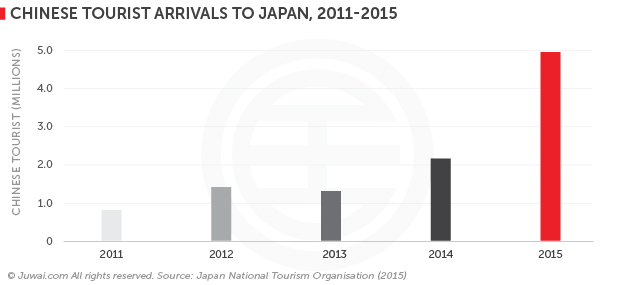
    More importantly, these policy changes appear to be paying off. A prime example is Japan, whose government relaxed requirements for three-year multiple-entry visas and started offering five-year multiple-entry visas for high-income groups during early 201510 – China arrivals in Japan doubled to 5 million in 2015, compared to 2.1 million in 2014.
     

    Broader horizons see Chinese tourists growing more adventurous

    However, the growing populace of Chinese tourists is an increasingly varied bunch with a widening range of locations filling up their bucket lists.

    As such, even countries not usually considered as standard tourist hotspots, such as Iran12 and Israel13, are also making their plays to catch a share of China’s outbound tourism market.

    Africa is also a case in point. Currently the fastest-growing port of arrival for Chinese tourists, Africa is seeing 80.9% annual growth in 2014, totalling an estimated 10.2 million trips.14 In fact, African nations, such as South Africa15, Egypt16, and Zimbabwe17, have all recently been falling over themselves to follow the lead of Mauritius’18 to offer visa-free entry.

    Asia – the most popular destination for outbound Chinese travellers, who numbered an estimated 98 million trips to the region in 201519 – just got even more accessible too. South Korea5, Malaysia20, New Zealand21, and Nepal22 have all announced new visa policies to boost their tourist industries.

    In the case of South Korea, this market is highly significant as six million tourists from China spent $22 billion last year, accounting for 1.6% of its GDP in 2015.5

    South America is making a play for China too. The 16,000-km trip from China just got a little easier to handle too – following Mexico, Peru, and Costa Rica who introduced similar visa policies in 2014, Ecuador23, Chile24, and Colombia25 have all introduced visa-free entry policies for Chinese tourists as well.

    Eyes on the prize: tourist spending and property investment

    Make no mistake, these policies are not just with tourism spending in mind. Investment from China’s increasingly outward-looking business sectors – which grew 51% y-o-y to 115 deals in Q1 2016 to be worth a total of $82.6 billion26 – and property investors figure prominently in the calculus behind looser visa policies.

    To an extent, countries around the world are taking their cue from Spain, Portugal, and other ‘Golden Visa‘ countries who went further than offering visa-free entries by loosening their visa policies in 2013 to offer residency in exchange for property and business investments.

    The results have been highly lucrative for agents in Spain and Portugal:

    • Portugal: 3,165 golden visas had been issued up to March 2016, with Chinese nationals accounting for about 80% – bringing in €1.92 billion of investment, of which €1.73 billion has been in the form of property investment.27
    • Spain: Chinese investors made 363 transactions worth a total of €268.4 million euros in 2014 and 2015.28

    Rapid impact of visa policy changes

    With such wide-ranging visa changes and increasing openness to business from China, governments are laying the foundations for what looks like continued growth in the coming years.

    Recent data from the US showed a 68% y-o-y increase in visas issued to Chinese tourists in Dec 2015 and January 2016 following the introduction of a 10-year visa shows that markets are already picking up. This is on top of the 68% surge that happened last year in Dec 2014 and January 2015.

    And looking across a wider range of countries, a clear pattern emerges – easier visa policies coincide with an increase in visitors. South Africa and Egypt have seen visitor numbers double at the start of 2016, and hotspots such as the UK and Singapore have seen 20%+ annual growth in tourist arrivals from China following their visa overhauls.
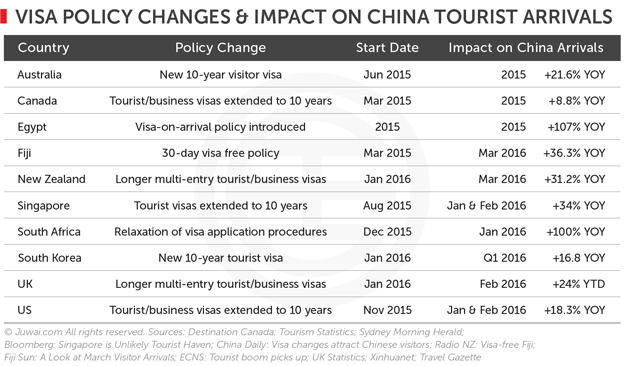
    Clearly, despite grand projections about the prospects and potential for outbound investment from China, such data compellingly shows that this market is growing and is already having a transformative effect on markets across the world.

    Beyond that, what’s also clear from our survey of recent government policy changes is that countries are increasingly looking to compete with each other for a share of this lucrative market.

    And if governments see the opportunity and are taking it seriously, then this clearly indicates that businesses – especially real estate – should too.

    Sources: 1. China Internet Watch: 220 million Chinese to travel overseas in 2025; 2. SCMP; 3. Channel News Asia; 4. SCMP; 5. Korea Tourism Organization; 6. The Pie: Australia rolls out SSVF, 10-year visa to China; 7. Daily Mail; 8. Travel Daily Media: Finland targets Chinese visitors; 9. Beijing Times; 10. China Daily; 11. Japan National Tourism Organisation; 12. Huffington Post; 13. Jerusalem Post; 14. Xinhua; 15. Quartz; 16. China Africa; 17. Santa Refelo: Immigration Update; 18. Wikipedia: Visa policy of Mauritius; 19. Goldman Sachs: The Chinese Tourist Boom; 20. Yibada: Malaysia Waives Visa Requirements for Chinese; 21. News Ghana; 22. Kathmandu Post; 23. TeleSurTv: Ecuador Welcomes Chinese Tourists; 24. China Daily; 25. China Daily; 26. China.org: Chinese firms set for record M&A; 27. SCMP; 28. Galleon: Spanish Golden Visa and the international citizenship programs 29. US: International Trade Statistics; 30. Destination Canada: Tourism Statistics; 31. Sydney Morning Herald; 32. Bloomberg: Singapore is Unlikely Tourist Haven; 33. China Daily: Visa changes attract Chinese visitors; 34. Radio NZ: Visa-free Fiji; 35. Fiji Sun: A Look at March Visitor Arrivals; 36. ECNS: Tourist boom picks up; 37. UK Statistics;38. Xinhuanet; 39. Travel Gazette