The myths, history and popular culture of Skyros
Many mythical figures such as Theseus, Achilleas, Neoptolemos and King Lycomedes have been linked
to Skyros. According to mythology, Achilleas departed from Skyros for the Trojan war from a small harbor
called even today Achilli. Skyros’ historical roots are in the Neolithic era (5500-2800 B.C.) its first
inhabitants being the pre-Hellenic Pelasgian, Karos and Dolopos tribes.
It flourished during the Early Bronze Age (1900-2800 B.C.) and reached its heyday during Mycenaean
period (1650-1100 B.C.). In the archeological site of Palamari, in the northern part or the island lies ones
of the most important prehistoric settlements in the Aegean. Dating back to the early and middle Bronze
Age (2550-1650 B.C.), it was a well- organized commercial port. The site is open to visitors and
excavations are still ongoing. The findings from the excavations are in the Archaeological Museum in
Chora Skyros where other findings from the Protohellenic, Mycenaean, Protogeometric and classical
periods are also on show.
In 475 B.C. the island passed into the hands of the Athenians, where it remained for 389 years until 86
B.C., and then became part of the Roman Empire and later the Venetian Empire. At that time Christianity
prevailed and many churches were built, , especially on top of the ruins of pre-Christian temples. The
Venetian Empire followed and then occypation by the Ottoman Empire. The churches and chapels are
scattered all over the island (count more than 360). Particularly interesting are the cave churches
inclundind Panagia Limbiani, , Agios Artemios, Panagia Spiliotissa and Agios Nikolaos at Pouria.
Despite the influences of history the island has its own authentic folk art. Sources of inspiration were the
sea, the natural landscape, animals and mythology.
Skyros is known nationwide for its small, carved wooden furniture, textiles and traditional pottery. A good
example are the “red” ceramics made of red clay without glaze, with decorative white linear designs,
reminiscent of embroidery. Tiny sofas, armchairs, stools, chests decorated with various carved motifs.
Skyros’ unique textiles and embroidery which are destined to decorate both the house and Skyrian
costumes
Many of these old artifacts are preserved in the Manos Faltaits Historical and Folk Art Museum, where
there is a model of the interior of an original Skyrian house.
A walk through the old town of Skyros reveals the singularity of the local architecture with its tiny houses
built amphitheatrically on the sides of a cliff below the Byzantine castle and the monastery og Ai-Giorgis.
Naturally Skyros has numerous manners and customs but the most important is the carnival with its roots
in antiquity and the Dionysian rites.
Carnival
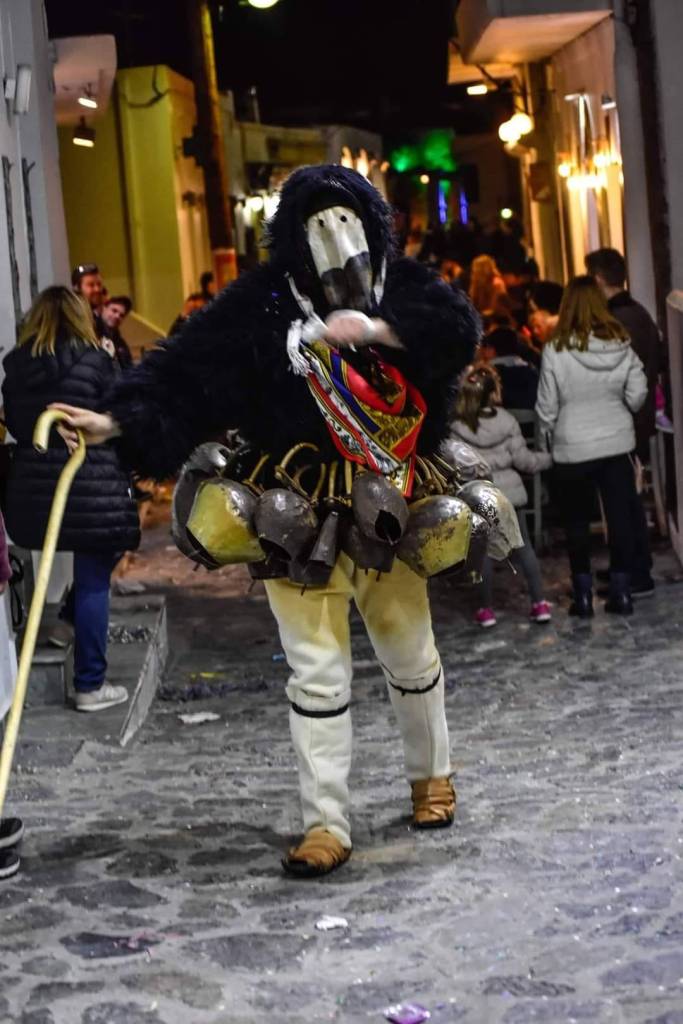
A Key feature of the Skyrian Carnival is the custom o “Geros” and “ Korela” which has Dionysian origins
and associated with the ancient feasts of fertility. Every year the carnival begins with the beginning o the
“Triodion” and is repeated every weekend, for about a month.
The last three days of Carnival, when the alleys of the city of Skyros resound with the sounds of bells,
while in the castle of the islnd famous “Dance of the Elders”.
On the Shorve Monday the custom of “Trata” takes place, which refers directly to an aristocratic custom
of maritime life with a measured recitation of satirical verses for the day and culminates with the mystical
dance of all the inhabitants of the island, in traditional local costumes in the central square.
The Skyrian Horse
The Skyrian horse: Sociable, intelligent, friendly
The Skyrian horse is an ancient Greek breed which survived only in Skyros! Νowadays, it numbers
around 190 members on the island and 300 worldwide. It is a small-sized breed unique in the world, and
scientifically known as Equus caballus Skyriano.
Due to its height, the Skyrian horse is often classified as a pony (ponies usually reach heights of 1.55m).
However, the anatomy of its body resembles that of horses, which means the Skyrian horse is one-of-a-
kind.
Skyrian horses are normally around 1.10m in height and feature long and thick manes, a unique body
type and a calm nature which makes them very friendly to people. This means the Skyrian horse
is perfect for children’s activities and hippotherapy sessions.
They constitute an important part of the island’s tradition: their participation in social and economic life in
Skyros used to be crucial since horses were part of agriculture for decades.
The history of Skyrian horses
Skyrian horses (Equus Cabalus Skyriano) are related to the small horses of Pindos Mountain in Greece
and are historically tied to the horses used by Achilles during his expedition to Troy, as well as to the
horses of Alexander the Great. Moreover, Skyrian horses are said to be depicted on. the Parthenon
frieze
The small horses of Skyros are related to small-sized horse breeds that migrated to Europe from Alaska
crossing the mountainous regions of Asia 12,000 years ago!
The breed that developed into the modern-day Skyrian horse is rumored to descend from
horses brought to Skyros by Athenian settlers during the 5th century BCE.
Although Skyrian horses are often referred to as “ponies” or “hipparions” (meaning little horses in Greek),
they are not in fact closely related. Hipparions were small-sized, three-toed horses that went extinct
around 1,000,000 years ago and are a different breed.
At ” Mouries Farm”, you can find out more about the history of Skyrian horses and get to know all about
their day-to-day lives!
The natural habitat of Skyrian horses
Mount Kochilas on the southeastern part of Skyros island is the natural habitat of Skyrian horses. This
is where the Skyrian horse lives freely.
The area of Mount Kochilas (or Kochylas) is home to a great variety of flora and fauna. It is a region of
unique ecological importance and diversity. As such, the natural habitat of Skyrian horses has been
designated as a protected area both for horses and bird species and is part of the NATURA
2000 network (more than 4,000 hectares).
The horses of Mount Kochilas on the southern part of Skyros live in small herds. They find refuge on
mountain plains, right next to small, forest-protected lagoons.
During the warm summer months, when food and water becomes scarce, Skyrian horses descend from
the mountain and head to the farms of their owners, where they receive proper care.


 Buy2Greece.com
Leave a comment