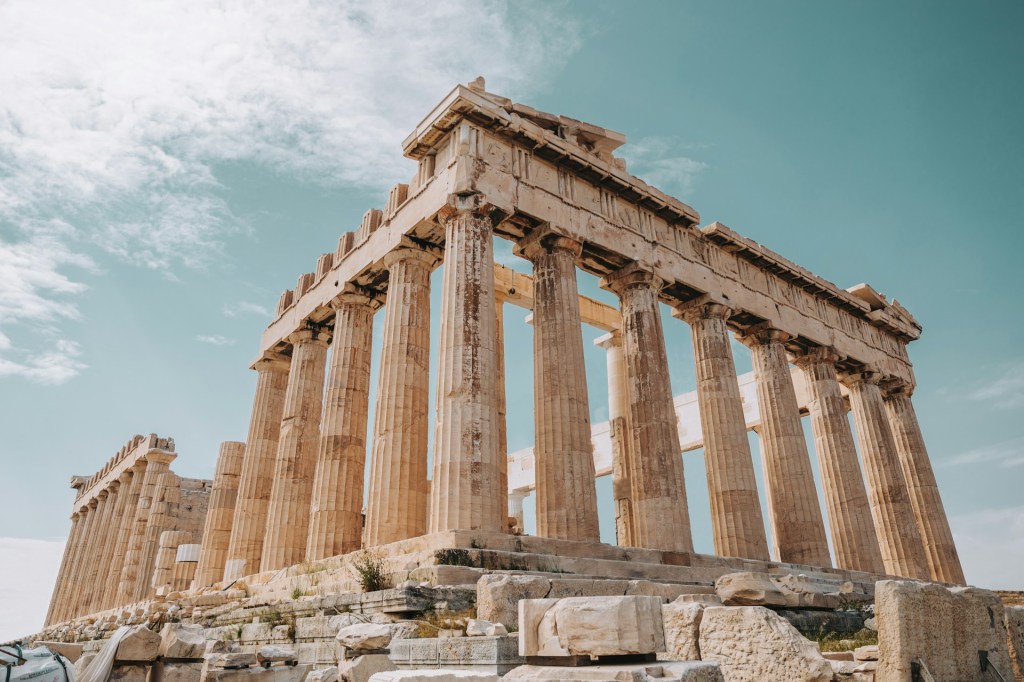
The Parthenon is the most iconic monument of classical Greece and one of the most influential architectural works in the history of Western civilization. Standing on the Athenian Acropolis, it represents the artistic, political and cultural achievements of Athens during its Golden Age. Beyond its monumental beauty, the Parthenon embodies the ideals of democracy, humanism and civic identity that shaped the ancient world.
In this article, we explore:
- The historical background of the Parthenon
- Its architectural innovations and design
- The religious and cultural role of the monument
- Its legacy and importance in modern times
Let’s begin with its origins.
Historical Background of the Parthenon
The Parthenon was constructed between 447 and 432 BC under the leadership of Pericles, during the period when Athens emerged as a dominant political and cultural force after the Persian Wars. It replaced an earlier temple—often called the “Pre-Parthenon”—that was destroyed when the Persians sacked the Acropolis in 480 BC.
The project was entrusted to two of the greatest architects of antiquity, Iktinos and Kallikratis, while the sculptural program was supervised by the renowned sculptor Phidias. The Parthenon became the centerpiece of a broader architectural vision that included the Propylaea, the Temple of Athena Nike and the Erechtheion.
Beyond its religious function, the Parthenon symbolised political power, civic pride and the unity of the Athenian people. It also served as a treasury, housing the wealth of the Delian League, which Athens effectively controlled during the 5th century BC.
Architectural Features and Innovations
The Parthenon is recognised as the finest example of Doric architecture, although it incorporates subtle Ionic elements, showcasing the exceptional mastery of the Athenian craftsmen.
Key architectural characteristics include:
- A peripteral structure with 46 outer columns (8 on the façades and 17 on the sides)
- Construction using Pentelic marble, known for its shimmering, almost golden hue under sunlight
- A floor plan measuring approximately 69.5 by 30.9 meters
- A combination of Doric proportions with Ionic decorative elements, such as the frieze encircling the cella
One of the most remarkable aspects of the Parthenon is its optical refinement. The architects introduced deliberate deviations from straight lines to create the illusion of perfect proportions:
- Columns swell slightly at the centre (entasis)
- The stylobate (platform) is gently curved
- Corner columns are slightly thicker and placed closer together
These refinements counteract visual distortions and make the structure appear absolutely straight and harmonious—a testament to the scientific and aesthetic sophistication of classical Athens.
Inside the temple once stood the monumental chryselephantine (gold and ivory) statue of Athena Parthenos, created by Phidias. This awe-inspiring sculpture stood over 11 meters tall and symbolised the protective presence of the goddess over the city.
Religious and Cultural Role of the Parthenon
Dedicated to Athena Parthenos, the patron goddess of Athens, the Parthenon played a central role in Athenian religion and public life. It housed sacred offerings and served as the focal point of major religious festivals, including the Panathenaea, during which Athenians honoured the goddess with ceremonies, athletic competitions and processions.
The temple’s rich sculptural program depicted mythological scenes that reflected Athenian values:
- The Panathenaic Procession on the Ionic frieze
- The battle between Lapiths and Centaurs on the metopes
- The birth of Athena and the contest between Athena and Poseidon on the pediments
These narratives celebrated order over chaos, civic harmony, divine protection and the cultural superiority that Athenians believed they embodied.
Over the centuries, the Parthenon adapted to new identities. It became a Christian church in the Byzantine era, a Latin church under the Franks and later a mosque during Ottoman rule. Despite these transformations, its architectural core remained intact for centuries.
The Parthenon in Modern Times
In 1687, the Parthenon suffered its greatest destruction when an Ottoman ammunition depot stored inside exploded after being hit by Venetian artillery. Much of the building’s roof and sculptures were lost, but the monument retained its imposing presence.
During the early 19th century, Lord Elgin removed many sculptures—now known as the “Elgin Marbles”—which remain housed in the British Museum, sparking ongoing debates regarding cultural heritage and repatriation.
Today, the Parthenon is the centerpiece of the Acropolis and one of the most visited archaeological sites in the world. An extensive restoration effort by the Greek Archaeological Service has been ongoing since the 1970s, using advanced conservation methods to stabilise and reconstruct parts of the structure with precision and respect for the original design.
The temple continues to inspire scholars, architects and visitors alike, symbolising the birth of democracy, the pursuit of excellence and the enduring legacy of classical Greek thought.
In Summary
The Parthenon stands as a masterpiece of ancient engineering, artistic expression and cultural identity. Its harmonious proportions, rich sculptural decoration and historical significance make it a defining monument of the classical world. More than a relic of antiquity, it remains a global symbol of intellectual achievement, civic pride and the timeless ideals of Athens.
 Buy2Greece.com
Leave a comment